Bridge Bidding Basics: How the Auction Works
This bridge bidding guide walks the whole auction from the opening bid to the final contract, in plain language. Bidding is how four players trade information using a fixed vocabulary of thirty-eight calls: thirty-five bids plus pass, double and redouble. Follow the guide in order and you will know what each bid promises, how to count your hand in points and shape, and which convention to reach for when. Nothing on this page is locked behind a paywall or an email opt-in.
Bidding in bridge is an auction in which the four players describe their hands using a fixed vocabulary of 35 bids, and it ends by naming the contract: how many tricks one side has committed to win, and which suit is trumps. Everything else in bridge bidding, every system and every convention, exists to make that description more accurate.
By Tracey Bauer
New to the game entirely? Start with How to Play Bridge: The Complete Beginner's Guide, then come back here.
This page is the map. It covers what the auction is, what each bid promises, how you measure a hand, and what the partnership is actually aiming at. Then it points you at the full explainer for every convention we teach, in the order a player usually meets them. Nothing here is behind a paywall.
What the auction actually is
After the cards are dealt, nobody plays a card until the auction is over. The dealer speaks first and the turn moves clockwise. At your turn you make one of four calls:
Bid. A number from one to seven plus a denomination: a suit, or no trump. 1♥, 2NT, 4♠.
Pass. You have nothing to add this round. Passing does not end your involvement, and you can bid later.
Double. Available only over an opponent's bid. At a high level it says you expect to beat that contract. At a low level it usually asks partner to bid, which is a different animal entirely.
Redouble. Available only over an opponent's double.
Each bid must be higher than the last one. The auction ends when a bid is followed by three passes in a row, and the last bid becomes the contract. If all four players pass at their first turn, the deal is thrown in with no contract.
That is the whole mechanism. The hard part is not the rules of the auction. The hard part is that you get 35 bids to describe 13 cards to a partner you are not allowed to talk to.
What a bid promises
Every contract starts from a base of six tricks, called the book. The number in your bid is how many tricks you promise beyond those six. So 1♥ promises seven tricks with hearts as trumps. 4♠ promises ten. 7NT promises all thirteen with no trump suit at all, which is a grand slam and is as good as it gets.
The denominations rank in a fixed order, lowest to highest: clubs ♣, diamonds ♦, hearts ♥, spades ♠, then no trump. That ranking is why the auction moves the way it does. Over 1♥ you can bid 1♠ or 1NT without going up a level, but a club or a diamond has to climb to the two level. Seven levels times five denominations is the 35 bids you have to work with, and the cheap ones are worth more than the expensive ones.
How you measure your hand
The common language is high card points. Ace 4, king 3, queen 2, jack 1, which puts exactly 40 in the deck. Shape matters too, because a five-card suit and a singleton are worth real tricks that no point count captures, but HCP is the number partners actually exchange.
Two house numbers to hold onto. Open the bidding with 12 or more high card points. Open 1NT with 15 to 17 and a balanced hand, which is the most precisely defined bid in the game and the reason so many conventions are built on top of it.
Here is what that buys you. Partner opens 1NT showing 15 to 17. You hold 10. You can do arithmetic nobody else at the table can see: 15 plus 10 is 25, and 25 is a game hand. That is the whole trick of bidding, and it is available to a beginner on their first night.
What you are aiming at
Three targets, and knowing which one is live changes every bid you make.
Partscore. Anything below game. Roughly 20 to 24 combined points. You are trying to land somewhere comfortable and stop.
Game. 3NT (nine tricks), 4♥ or 4♠ (ten), 5♣ or 5♦ (eleven). Around 25 to 26 combined points. Notice the minors need two more tricks than notrump for the same reward, which is why 3NT is so often the right game even when you hold a nine-card minor fit.
Slam. Twelve tricks at the six level, thirteen at the seven level. Small slam wants about 33 combined points, grand slam about 37, and both want you to know how many aces are missing before you commit.
An auction that finds the right target and stops there beats a clever auction that lands in the wrong contract.
The conventions, and where each one fits
A convention is an agreement that gives a bid an artificial meaning, so it says something the natural bid could not. Both opponents are entitled to know every agreement you play, which is why partnerships write them down. You do not need any of these to start playing. You meet them roughly in this order.
Opening and responding
Two Over One is a full system rather than a single convention. A new suit at the two level over partner's one-level major opening forces to game, so neither player has to jump to show strength and the auction has room to breathe.
The Strong 2♣ opening is the one opening with no ceiling: 22 or more points, or about eight playing tricks. It says nothing at all about clubs.
Mel's Rule of 23 is not a convention but a judgment rule, and it will save you more points than most conventions will: do not bid 2NT in a later round unless your side holds at least 23 high card points.
After a 1NT opening
Stayman. A 2♣ response asks a question rather than showing clubs: partner, do you hold a four-card major? Opener answers 2♥ or 2♠ with one, 2♦ with neither.
Jacoby Transfers. A 2♦ response commands opener to bid 2♥, and 2♥ commands 2♠. You show a five-card major and the strong hidden hand becomes declarer, so the opening lead comes around to it rather than through it.
Smolen picks up where Stayman gives up. After 1NT - 2♣ - 2♦, responder jumps to three of the shorter major to show five in the other one, which keeps the 5-3 fit findable and keeps the strong hand as declarer.
Garbage Stayman is the exception to Stayman's point requirement. Hold four cards in each major and shortness in clubs, and you bid 2♣ with almost nothing, planning to pass whatever opener answers. Your own diamond length is what makes opener's 2♦ answer a better resting place than 1NT, because that answer promises nothing about diamonds.
When the opponents bid too
Takeout Doubles. A low-level double of their opening does not mean you want to defend. It asks partner to pick a suit, and it is the most useful competitive tool a new player can own.
Negative Doubles. Partner opens, an opponent overcalls, and your natural bid has been stolen. The double shows the suits you can no longer bid.
Bidding a slam
Blackwood, devised by Easley Blackwood in 1933, asks partner how many aces they hold. This house plays Roman Keycard 1430, which counts the trump king as a fifth keycard and asks about the trump queen as well.
Writing your agreements down
The convention card is where a partnership records what all of the above means for the two of you. It is also the fastest way to discover you and your partner do not agree.
After the auction ends
The auction is only half the game. Once the contract is set, one side has to bring it home and the other has to stop it.
Play of the hand covers making a plan before you play to trick one, counting your tricks, and knowing which ones you have to build.
Defensive signals and carding cover the other side of the table: attitude, count, suit preference, and which one applies when.
Bridge scoring is what the result is worth: trick values, the game and slam bonuses, what going down costs when you are vulnerable or doubled, and how matchpoints and IMPs change which of those you should chase.
Reference
The bridge glossary defines 100 terms in plain English, so a word you meet mid-auction has somewhere to go.
Bidding as partnership communication takes the same material from the other direction: what two people have to agree on before they sit down.
Bridge partner tips is the human side of the same problem: what the laws expect on tempo and alerts, what to do when partner explains your bid wrong, and how to review a session without blame.
How to actually get better at bidding
Reading about bidding is worth something. Bidding hands is worth more. Three ways in, in increasing order of commitment.
The 50 Conventions in 50 Days series sends you one convention a day in plain English, which is a low-pressure way to meet a lot of them without deciding anything in advance.
Each workshop replay includes 4 to 5 hours of video, a 30 to 50 page workbook, a two-page cheatsheet, and hands to practice on BBO or BridgeChamp. The recordings include the two-hour lesson and two hours of Play of the Hand. Upcoming live sessions are recorded afterward. The practice hands come as PBN files. Use them in BridgeChamp or another PBN-compatible platform. For BBO, convert them to LIN if its import tool requires that format. Choose your topic from the workshop library.
Ready to explore a specific bidding decision? Read the Inverted Minors guide for minor-suit raises, or the Help Suit Game Tries and Spiral Raises guide for deciding whether your fit belongs in game.
The VIP membership bundles the workshop library for players who would rather work through the whole thing than pick one topic at a time.
And whichever route you take: play the hands. Clumsy auctions you learn from beat perfect auctions you copied.
A complete first auction, call by call
Here is one whole auction, from the first call to the final pass, with all four hands on view. North is the dealer, so North speaks first and the calls go round the table clockwise. East and West pass all the way through, which keeps this first example simple.
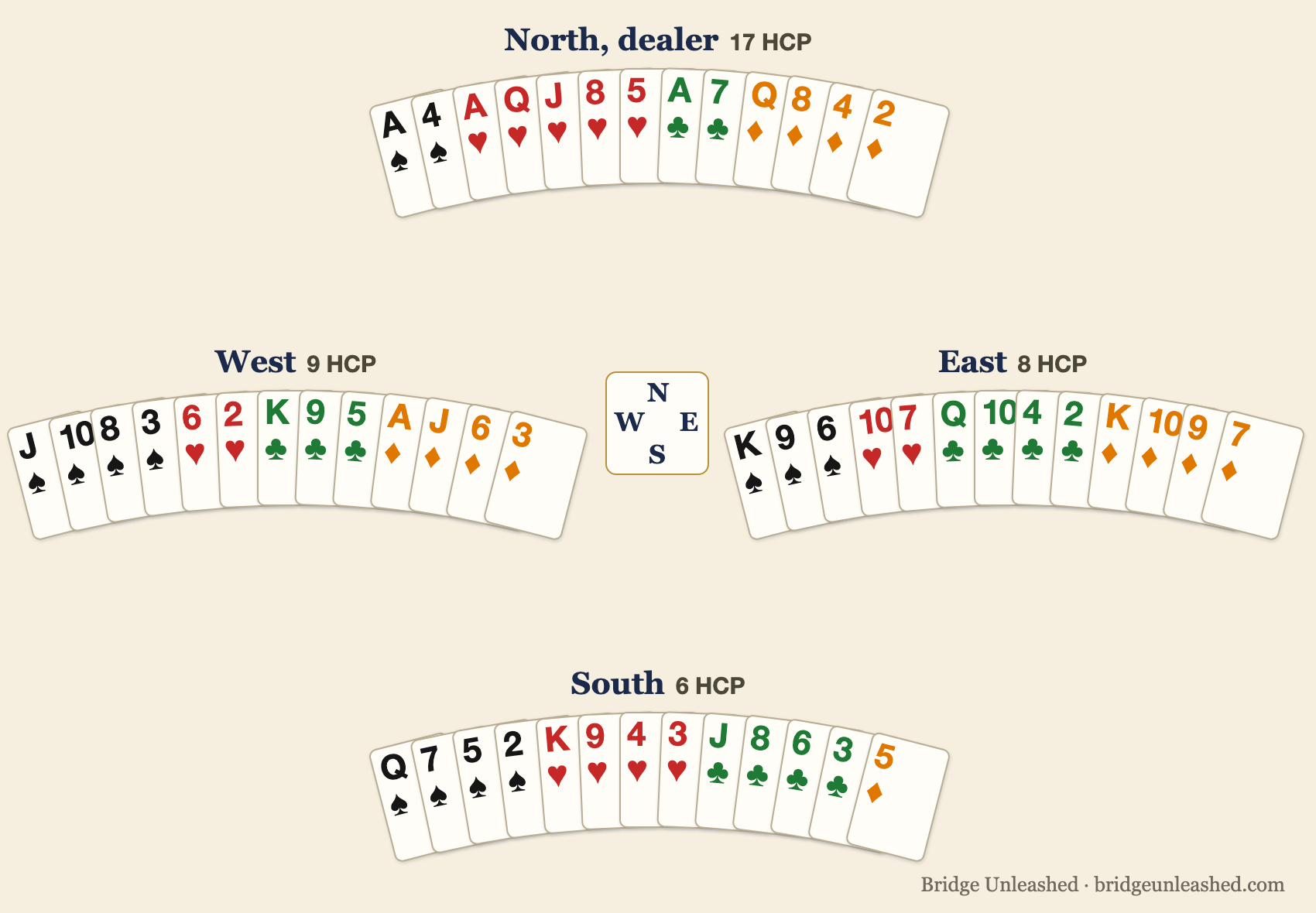
| Seat | Call | Why |
|---|---|---|
| North | 1♥ | 17 high card points plus 1 for the fifth heart makes 18. Two doubletons (two-card suits) means not balanced, so no 1NT: open the five-card major. |
| East | Pass | 8 points and no five-card suit, so nothing worth showing. |
| South | 2♥ | Four hearts, so a fit. 6 high card points plus 3 for the singleton diamond (once you have a fit, a short suit counts) is 9, a raise to two. |
| West | Pass | 9 points and no five-card suit. Pass. |
| North | 3♥ | 18 is a medium opening (16 to 18). North invites: partner, bid game if your raise was at the top. |
| East | Pass | Still nothing to say. |
| South | 4♥ | 9 is the top of the 6 to 9 raise, so South accepts and bids game. |
| West | Pass | The first pass after the last bid. |
| North | Pass | Partner has placed the contract, so North has no reason to bid again. |
| East | Pass | Three passes in a row after a bid. The auction is over. |
The contract is 4♥ by North: ten tricks with hearts as trumps. North is declarer because North was the first player in the partnership to name hearts. East, on declarer's left, makes the opening lead, and South's hand goes face up on the table as dummy. Played perfectly by both sides, 4♥ makes exactly ten tricks, so the bidding found the right spot.
Notice how little each player said, and how much it told partner. North's first bid promised 12 or more points and five hearts. South's raise promised a fit and 6 to 9. North's 3♥ asked one question, and South's 4♥ answered it. That is the whole idea of bidding: two hands, described in a few short sentences, landing on a contract neither player could have chosen alone.
Opening bid chart (free to print)
This is the whole opening decision on one page. Check the rows in order from the top and open with the first one that fits your hand. To print it, click the chart to open it on its own, then print that page.
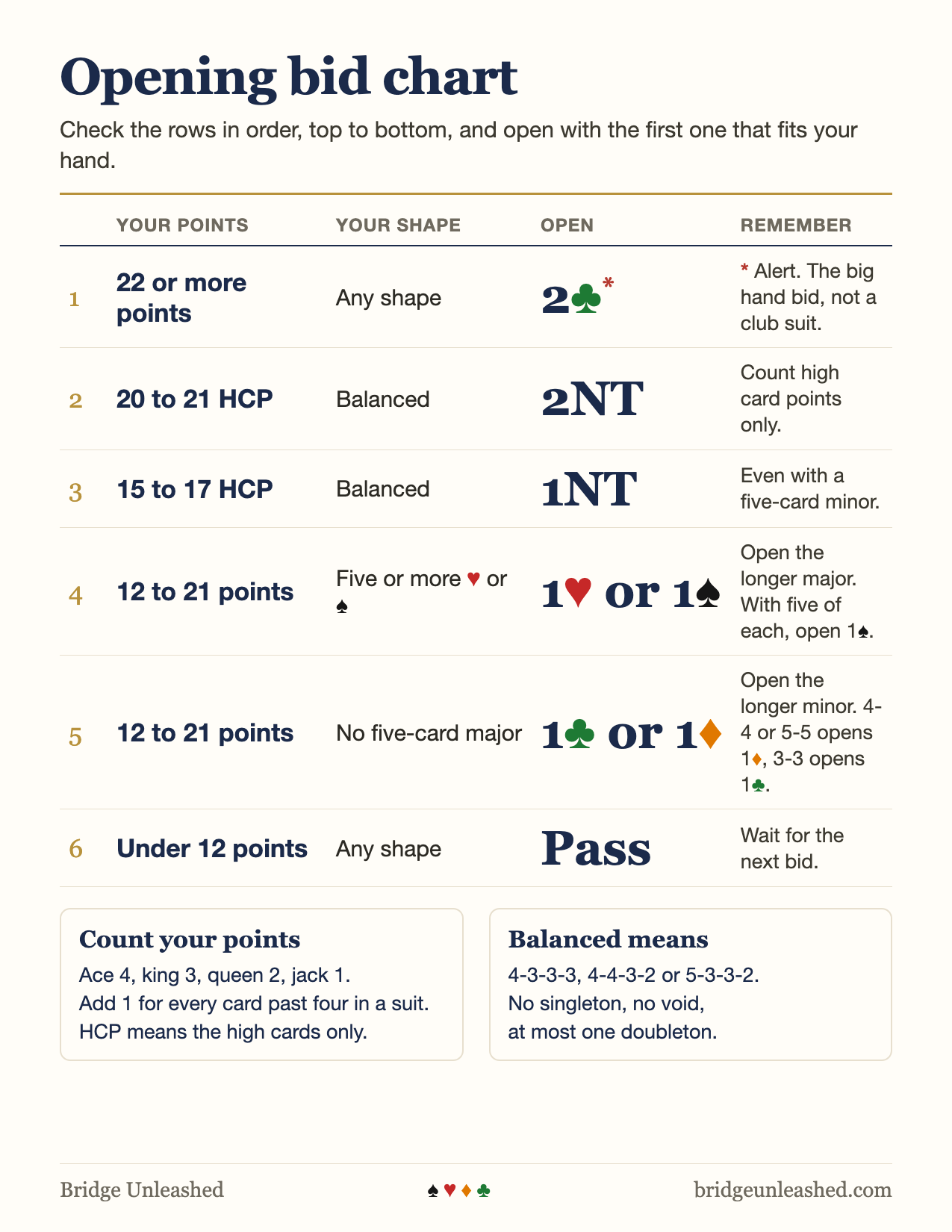
| Your hand | Open |
|---|---|
| 22 or more points, any shape | 2♣* |
| 20 to 21 high card points, balanced | 2NT |
| 15 to 17 high card points, balanced | 1NT |
| 12 to 21 points, five or more hearts or spades | 1♥ or 1♠ |
| 12 to 21 points, no five-card major | 1♣ or 1♦ |
| Under 12 points | Pass |
* Alert. The 2♣ opening is artificial: it shows a very strong hand, not a club suit, so partner tells the opponents. Points means high card points plus one for every card past four in a suit. Balanced means 4-3-3-3, 4-4-3-2 or 5-3-3-2.
Test yourself: five bidding questions
Click an answer to see whether it is right. Questions 1 to 4 follow the chart above; question 5 follows the auction.
1. You are the dealer. ♠ K J 7 ♥ A Q 4 ♦ K 10 8 3 ♣ Q 9 2
1♦
Not quite. Check the chart from the top: 15 high card points and a balanced 3-3-4-3 shape fit the 1NT row before you ever reach the minors.
1NT
Right. 15 high card points, balanced. 1NT tells partner almost everything in one bid.
2NT
Not quite. 2NT shows 20 to 21. With 15, the balanced bid is 1NT.
2. You are the dealer. ♠ A Q 9 6 4 ♥ K 7 ♦ K J 5 2 ♣ 8 3
Pass
Not quite. 13 high card points plus 1 for the fifth spade is 14. That is an opening bid.
1♦
Not quite. With a five-card major, open the major. The diamonds can wait for your second bid.
1♠
Right. 14 points and five spades: open one of your major.
3. You are the dealer. ♠ K 8 3 ♥ Q 7 2 ♦ A J 6 ♣ K J 5 4
1♣
Right. 14 is too few for 1NT and there is no five-card major, so open the longer minor. Four clubs beat three diamonds.
1♦
Not quite. Open the longer minor. Clubs has four cards, diamonds has three.
1NT
Not quite. The shape is balanced, but 1NT needs 15 to 17 high card points. This hand has 14.
4. You are the dealer. ♠ Q 8 5 ♥ J 9 6 3 ♦ K Q 4 ♣ J 7 2
Pass
Right. 9 points is under 12. Pass now, and you can still come in later if partner opens.
1♥
Not quite. One of a major needs 12 or more points and five cards. This hand has 9 points and four hearts.
1♣
Not quite. Any opening needs 12 or more points. This hand has 9.
5. Partner opens 1♥. You hold ♠ K 10 5 3 ♥ Q 8 4 ♦ 7 6 2 ♣ K 9 3
Pass
Not quite. 8 points is enough to respond. Passing could leave a game behind.
2♥
Right. Three hearts is a fit, and 8 points with no short suit is a raise to two (6 to 9).
4♥
Not quite. 8 points is a raise to two (6 to 9). Let partner decide whether to go further.
Frequently asked questions
What is bidding in bridge?
Bidding in bridge is an auction in which the four players describe their hands using a fixed vocabulary of 35 bids. It ends by naming the contract: how many tricks one side has committed to win, and which suit is trumps or whether the hand is played in no trump. The auction ends when a bid is followed by three passes in a row.
What does a bridge bid actually promise?
Every contract starts from a base of six tricks, called the book, so the number in a bid is how many tricks you promise beyond those six. A bid of 1♥ promises seven tricks with hearts as trumps, 4♠ promises ten, and 7NT promises all thirteen with no trump suit.
How many points do you need to bid game in bridge?
Around 25 to 26 combined high card points between the two hands is the working number for game. Game is 3NT for nine tricks, 4♥ or 4♠ for ten, or 5♣ or 5♦ for eleven. Because the minor-suit games need two more tricks for the same reward, 3NT is often the better game even with a long minor.
What is the difference between a bid and a convention?
A natural bid means roughly what it says: 1♥ shows hearts. A convention is a partnership agreement that gives a bid an artificial meaning instead, such as a 2♣ response to 1NT asking whether opener holds a four-card major. Conventions let partners exchange information no natural bid could carry, and both opponents are entitled to know every agreement you play.
What order do the suits rank in bridge bidding?
Lowest to highest: clubs ♣, diamonds ♦, hearts ♥, spades ♠, then no trump. That ranking decides how much room a bid costs. Over 1♥ you can bid 1♠ or 1NT at the same level, but a club or diamond bid has to climb to the two level.
What is the best bridge bidding guide for a beginner?
Start with a bridge bidding guide that covers the whole auction in order: what bidding is, what each bid promises, how to count your hand, and how the partnership lands on a contract. This page is built that way, then links out to full lessons on the conventions Bridge Unleashed teaches.
What is the opening bid in bridge?
The opening bid is the first bid of the auction, made by the first player who does not pass. With 12 or more points you open: 1NT with a balanced 15 to 17 high card points, 2NT with a balanced 20 to 21, one of a major with five or more cards in it, and otherwise one of your longer minor. With 22 or more you open 2♣*, the big hand bid (* alert: it shows a very strong hand, not clubs). With fewer than 12, you pass.
How do you respond to a suit opening in bridge?
With fewer than 6 points, pass. With three or more cards in partner's major, raise it: 6 to 9 points to the two level, 10 to 12 to the three level. Over a major without support, bid a new suit of four or more cards at the one level if you can, bid 1NT with 6 to 9, or with 10 or more bid a new suit at the two level. Over a minor opening, show a four-card major first.
What is opener's rebid in bridge?
Opener's rebid is the opening bidder's second bid, and its job is to tell partner how strong the opening was: minimum (12 to 15), medium (16 to 18) or maximum (19 to 21). After partner raises your major to two, pass with a minimum, bid three with a medium to invite game, and bid game with a maximum. After a new suit from partner, raise it with four-card support, rebid notrump with a balanced hand, repeat your suit, or bid a new lower-ranking suit.
Prefer to watch?
Same idea, on video, free to watch.
