Mel's Rule of 23: The Simple Rule That Will Save Your Bridge Game
By Tracey Bauer
If you've ever found yourself staring at your hand mid-auction wondering whether to bid 2NT — and then watched helplessly as partner's face crumpled — this post is for you.
Bridge teacher and author Mel Colchamiro has a gift for distilling complex bidding concepts into crystal-clear rules. His Rule of 23 is one of those rare insights that, once you hear it, makes you wonder how you ever played without it. It has two parts, and both will change how you approach competitive auctions.
Part 1: Don't Bid 2NT Without 23
Here's the rule:
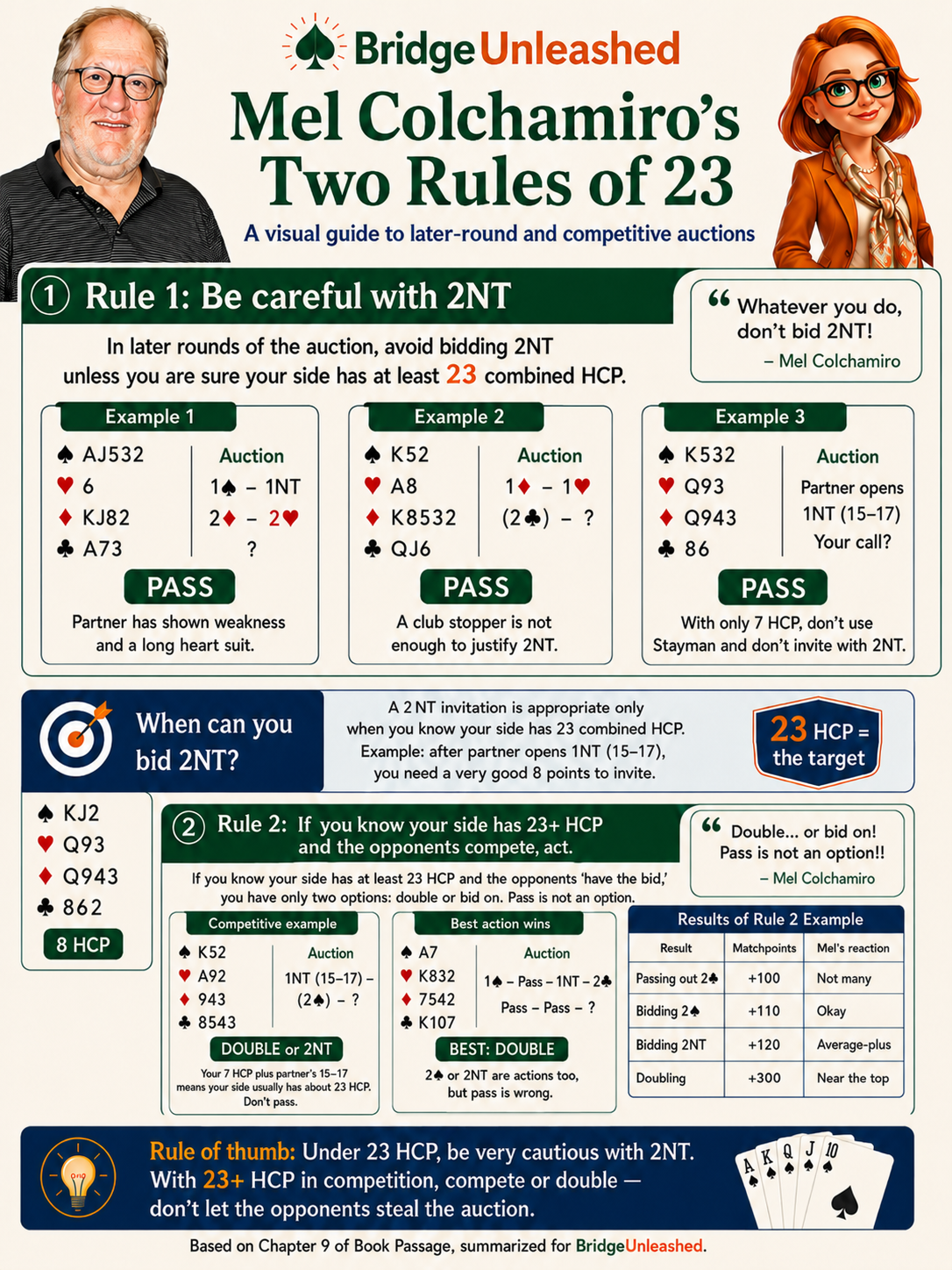
In later rounds of the bidding, avoid bidding 2NT unless you are sure your side has at least 23 HCP.
New to bidding? Start with How to Play Bridge: The Complete Beginner's Guide, then come back for the Rule of 23.
Simple. But the implications are enormous — because most players bid 2NT far too often.
Why 23?
2NT is a contract for eight tricks — almost two-thirds of the total tricks in the hand. To succeed in notrump, you generally need around half the high card points. Since there are 40 HCP in the deck, half is 20 — enough for most part-scores. But 2NT is asking for more than average, and if you're going to try for eight tricks, you need the firepower to back it up. The magic number is 23 combined HCP.
The real danger? In later rounds of the auction, partner has already described a weak hand. Bidding 2NT when you can't possibly have 23 combined is a recipe for disaster.
Three Hands to Learn From
Hand 1 — You hold: ♠ AJ532 ♥ 6 ♦ KJ82 ♣ A73 (11 HCP)
The auction goes: You open 1♠, partner responds 1NT, you bid 2♦, partner bids 2♥. Don't bid 2NT! Partner's 2♥ shows weakness — usually fewer than 10 points with long hearts. Just pass and let partner's long hearts do the work. In notrump, those hearts are worthless.
Hand 2 — You hold: ♠ K52 ♥ A8 ♦ K8532 ♣ QJ6 (11 HCP)
Partner opens 1♦, you respond 1♥, and RHO overcalls 2♣. You have a balanced hand and a club stopper — doesn't that scream 2NT? No! Partner has six-to-seven points. You have 11. That's 17 or 18 at best. If partner has a stronger hand, she'll have another chance to bid. Just pass.
Hand 3 — You hold: ♠ KJ7 ♥ 5 ♦ Q943 ♣ Q8532 (13 HCP)
LHO opens 1♠, partner overcalls 2♥, and now you're tempted by 2NT. Still no. Partner's two-level overcall promises around 13 HCP, but she almost certainly has a singleton spade. Pass. Too often, 2NT here leads to 3NT and a lot of screaming from partner!
When CAN You Bid 2NT?
You hold: ♠ K532 ♥ Q93 ♦ Q943 ♣ 86 (7 HCP). Partner opens 1NT (15-17).
Now the math works: 15 (partner's minimum) + 8 (your "very good" 7 points) = 23 HCP. Bid 2NT with confidence as an invitation to game.
Part 2: Birdies, Pars, and Bogeys
This is where the Rule of 23 gets really interesting. Mel uses a golf analogy: when you hear "That's a four for Tiger on the sixth hole," you can't evaluate it without knowing par. Bridge has a par too — what every other pair playing the same cards is likely to score.
The second part of Mel's Rule of 23 deals with competitive auctions — when the opponents are trying to steal the contract right out from under you.
If you know your side has at least 23 HCP and the opponents "have the bid," you have only two options: Double... or bid on! Pass is not an option!!
Why Is Passing So Bad?
When you have the balance of power (23+ HCP) and the opponents are playing in a part-score contract undoubled, you are letting them score points they haven't earned. Passing is the equivalent of yelling "Have a nice day!" at someone who just stole your wallet.
In a real matchpoint game, +50 from setting them one trick undoubled might feel okay — but if your side can make +90 or +120 in your own contract, you've just given away precious matchpoints.
A Real-World Example
You hold: ♠ K52 ♥ A92 ♦ 943 ♣ 8543 (7 HCP). Partner opens 1NT (15-17) and RHO overcalls 2♠.
With 7 HCP and partner's average of 16, your side has 23 combined points. The opponents have only 17. They are stealing from you. Don't pass — Double or bid 2NT.
The Matchpoint Double
These competitive doubles — when you know you have the balance of power — are sometimes called "matchpoint doubles."
If they go down: you get a plus score, often a big one.
If they make: at matchpoints, "it's just another bottom" — barely costs more than passing.
The math strongly favors acting. Even when the doubled contract makes, passing was still the wrong choice long-term.
The Lesson in a Scoresheet
Mel shows a real duplicate scoresheet from 1993 where several East-West pairs played 2♥ or 3♥ undoubled and got terrible scores — simply because their opponents passed when they had the majority of HCP. East-West had the cards. North-South had the bid. The pairs who didn't act essentially handed North-South a gift.
Putting It All Together
Mel's Rule of 23 teaches two fundamental ideas:
Don't overreach in notrump. 2NT promises eight tricks. Without 23 combined HCP, you're playing against the odds. Trust the rule, trust your partner, and pass.
Don't let opponents steal from you. When you know your side has 23+ HCP, you must act — double or bid. Passing gives opponents exactly what they want.
The most dangerous word in competitive bridge is "pass" — when you have the cards to fight back.
One Final Thought
Mel Colchamiro says the Rule of 23 won't always tell you what to do. More importantly, it will tell you what not to do. And in bridge, avoiding the losing action is often the biggest step toward winning.
Next time you're tempted to bid 2NT on 11 HCP, remember: 23 is the number. And next time the opponents try to steal the bid with your points, remember: pass is not an option.
Play smart. Count to 23.
This kind of competitive bidding judgment sits inside the bigger auction picture the Bidding Basics guide lays out, and it's what you drill hand by hand in the workshops.
Questions players ask about the Rule of 23
What is Mel's Rule of 23 in bridge?
It is a two-part guideline from bridge teacher Mel Colchamiro. In later rounds of the bidding, do not bid 2NT unless you are sure your side holds at least 23 high card points. And when you know your side holds 23 or more and the opponents have the bid, passing is not one of your choices: you double or you bid on.
Why does 2NT need 23 combined high card points?
2NT is a contract for eight tricks, almost two-thirds of the tricks in the hand. There are 40 high card points in the deck, so an even split is 20, which is enough for most partscores. Eight tricks in notrump asks for more than an even split, and 23 is the number that backs the bid.
What does the Rule of 23 say when the opponents have the bid?
Act. If you know your side holds at least 23 high card points and the opponents have the bid, you have two choices, double or bid on. Passing hands them a partscore they did not earn, and at matchpoints it gives away the score your own contract could have made.
What is a matchpoint double?
It is a competitive double made when you know your side holds the balance of power. If the contract goes down you take a plus score, often a large one. If it makes, at matchpoints it is close to another bottom, which barely costs more than passing. The odds favor acting.
Does the Rule of 23 tell you what to bid?
Not always, and Mel Colchamiro says so himself. What it reliably tells you is what not to do: do not stretch to 2NT without the points behind it, and do not pass when the opponents are buying a contract against a side that holds the majority of the strength.
Prefer to watch?
Same idea, on video, free to watch.
