Six ♥ and a modest point count can make 2♥ an appealing opening. But six weak ♥, six strong ♥ and six ♥ beside a useful second suit are different hands. A good weak two gives partner a clear picture while making the opponents start their conversation higher.
Agree what six cards should look like
Tracey's workshop teaches weak openings of 2♦, 2♥ and 2♠ with exactly six cards and 5 to 10 high card points. The normal suit-quality standard is two of the top three honors. That gives partner something useful to picture before deciding whether to pass, raise or investigate game.
Compare ♠ K Q J 8 7 3 with ♠ Q 8 6 5 4 2. Both contain six cards, but they promise very different sources of tricks. In the workshop's disciplined starting style, the first passes the suit-quality test. The second needs a much better reason to enter the auction.
These are partnership agreements, not universal laws. Some experienced pairs use a wider range or different standards for suit quality. The mistake is using one style while partner expects another. Keep 2♣ separate: the Strong 2♣ guide explains the strong opening that frees the other two-level suit openings for preempts.
Look beyond the long suit
A side four-card major is a strong reason to reconsider a weak two. With six ♥ and four ♠, opening 2♥ can make a useful ♠ fit hard to find. Tracey's starting guidelines also avoid a void and outside strength that makes the hand more suitable for a one-level opening.
The purpose is to describe a fairly limited hand in one bid. If your shape and controls make you want a longer conversation, ask whether you are choosing an opening that leaves room for it. Counting six cards is the start of the decision.
Seat and vulnerability change the decision
In first or second seat, partner may still have a very strong hand. A disciplined opening lets that partner judge the combined assets. In third seat, partner has passed, so there is more room for a disruptive opening. Agree how much your style changes before you sit down.
Vulnerability matters because the cost of going down changes. Be more demanding about your suit when vulnerable, especially against nonvulnerable opponents. An aggressive opening can make sense without being compulsory on every six-card suit.
Fourth seat is different again. After three passes, you can end the auction by passing. A two-level opening there needs a constructive reason; don't automatically apply the same weak range you use in first seat.
Responder can ask with Ogust
After 2♠ - 2NT, this workshop uses Ogust. The 2NT response is artificial and asks about both hand strength and suit quality. It is not an offer to play notrump. The agreed answers are:
- 3♣: bad hand, bad suit.
- 3♦: bad hand, good suit.
- 3♥: good hand, bad suit.
- 3♠: good hand, good suit.
- 3NT: a solid suit headed by A K Q.
Here, “bad hand” means 5 to 7 points and “good hand” means 8 to 10. A good suit has two of the top three honors. The lower-quality answers accommodate the lighter openings your partnership permits in the right circumstances.
Thus 2♠ - 2NT - 3♦ shows the lower point range with a good ♠ suit. The 3♦ bid says nothing about a natural ♦ holding. Some pairs use 2NT to ask for a side-suit feature instead. That is a different agreement; this workshop uses Ogust.
Ask only when the answer helps you decide
Before bidding 2NT, think through your action over a minimum and a maximum answer. If you will bid the same contract either way, the extra exchange may only help the defenders. If the answer changes whether you stop or bid game, you have a reason to ask.
A direct raise such as 2♠ - 3♠ is further preemption in this treatment, not an invitation. A new-suit response is natural and forcing. Those meanings matter as much as the Ogust ladder: opener must know which bids allow a pass.
When the opponents open the weak two, start a separate set of agreements. A double normally asks for takeout, while a direct natural 2NT overcall shows a strong balanced hand with a stopper. The Takeout Doubles guide is a useful companion to that side of the auction.
Take the decisions to the table
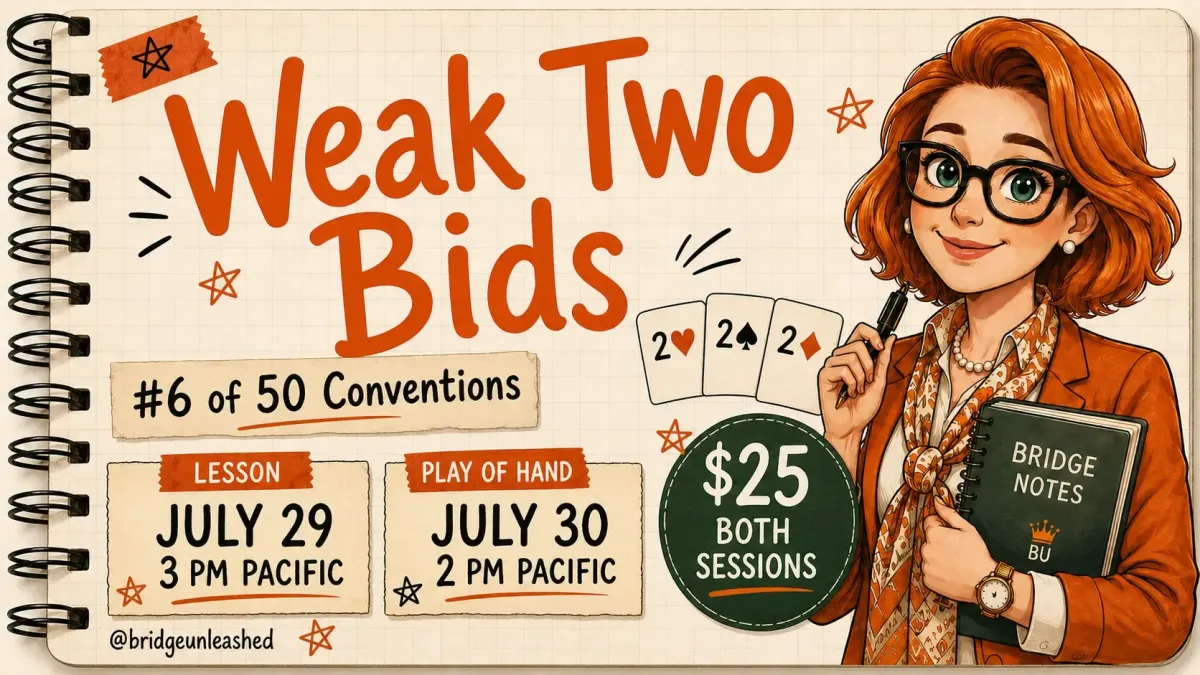
The Weak 2 Bids Workshop replay includes the two-hour lesson and two-hour Play of the Hand, about 4 to 5 hours of video in total, a 30 to 50 page workbook, a two-page cheatsheet and PBN practice hands, for $25.
Pause before opener or responder acts, choose your bid, then compare it with the discussion. Practice the hands on BBO or BridgeChamp. Use the PBN files in BridgeChamp or another PBN-compatible platform. For BBO, convert them to LIN if its import tool requires that format.
