Roman Key Card Blackwood 1430: The Full Guide
By Tracey Bauer
Roman Key Card Blackwood 1430 is the slam convention that counts five cards instead of four: the four aces plus the king of trumps. A single bid of 4NT asks partner how many of those five they hold, and one more cheap bid asks about the queen of trumps. The name "1430" is the first two answers read in order: one or four key cards, then three or zero. Learn the ladder once and you stop bidding slams that are missing two key cards.
If 4NT is new to you, start with our Blackwood convention guide, which covers the classic version that counts only aces. This post is the next step: how to read every answer, how to ask for the queen and the kings, how 1430 differs from 0314, what a void does to the answers, and the times 4NT is not a key card ask at all.
How Roman Key Card Blackwood 1430 Works
Roman Key Card Blackwood, shortened to RKC, is asked with 4NT when spades are the agreed trump suit. For the other suits the house usually moves the ask, as the Kickback note below explains. Every example below uses spades as trumps, so 4NT is the ask and the answers climb from 5♣ to 5♠. That detail matters: with spades, every normal answer comes at or below 5♠, so you can always stop there if the answer disappoints you.
The auctions in this post show artificial calls with an asterisk, and the key under each one reads "* alert". An artificial call is a bid that does not mean what it says, like 4NT asking a question instead of naming a contract.
The Five Key Cards
A key card is one of the four aces or the king of the agreed trump suit. Five in all. The trump king counts because, at the six level, it matters as much as an ace does.
Only the trump king counts. With spades as trumps, the ♠K is a key card and the ♥K, ♦K and ♣K are not. With hearts agreed, the ♥K is the key card instead. The queen of trumps is not a key card either. Because it still decides slams, the convention tracks it separately, and that is what the queen ask is for.
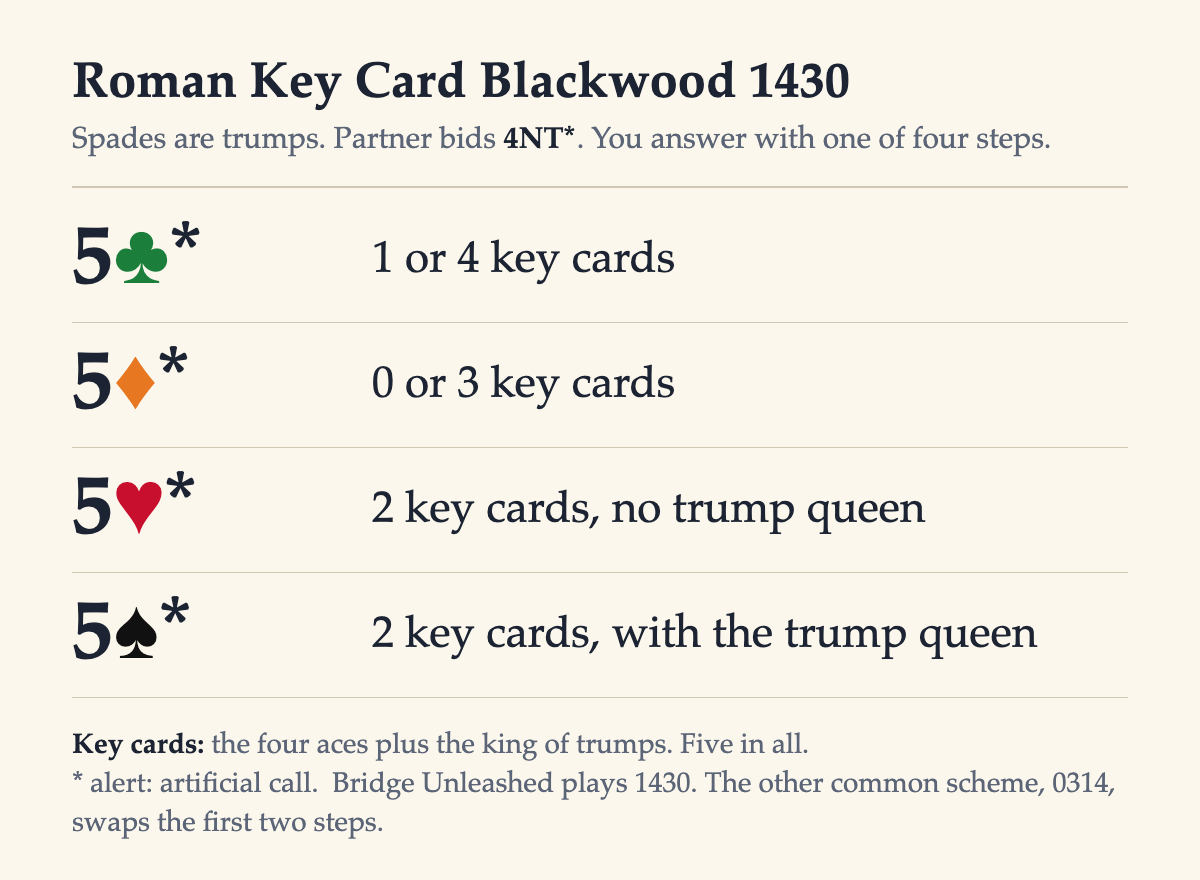
The 1430 Responses
Partner bids 4NT* and you answer with one of four steps. Spades are trumps in every line below.
| The auction | You hold | What it shows |
|---|---|---|
| 1♠ - 3♠ - 4NT* - 5♣* | ♠ 9 7 5 3 ♥ K 8 3 ♦ A 7 2 ♣ K 9 5 | One key card, the ♦A. The ♥K and ♣K are side kings, so they do not count. Hold four of the five key cards and you also bid 5♣*, because four is the other half of "one or four". |
| 1♠ - 3♠ - 4NT* - 5♦* | ♠ Q 9 6 4 ♥ K J 8 ♦ K 7 3 ♣ J 6 2 | No key cards, because the ♥K and ♦K are side kings. This hand has the ♠Q, but the 5♦* answer does not say so. That is the queen ask's job. |
| 1♠ - 3♠ - 4NT* - 5♥* | ♠ K 8 6 4 ♥ A 9 7 ♦ Q 5 3 ♣ J 6 2 | Two key cards, the ♠K and the ♥A, and no ♠Q. |
| 1♠ - 3♠ - 4NT* - 5♠* | ♠ Q 8 6 4 ♥ A 9 7 ♦ 5 3 2 ♣ A 6 2 | Two key cards, the ♥A and the ♣A, and the ♠Q. Same ten points as the hand above, a different answer, because the answer depends on which cards you hold, not how many points. |
* alert: artificial call.
How does the asker tell one from four, or zero from three? Mostly by counting their own key cards. If you hold three and partner answers "zero or three", partner has zero, because you cannot both hold three of the five. If you hold two and partner answers "one or four", partner has one. The bidding so far settles most of the rest.
Count What Is Missing
The rule I teach is to count what is missing, not what you hold. Missing zero or one key card, the small slam can be bid if the rest of the hand supports it. Missing two, stop at five of the trump suit. Two missing key cards are two fast losers, and slam rarely survives that.
Here is the rule at work. South opens 1♠ and North raises to 3♠, a limit raise showing four trumps and 10 to 12 points.
| Hand | ♠ | ♥ | ♦ | ♣ | High card points |
|---|---|---|---|---|---|
| North | J 8 6 2 | K J 8 4 | K J 6 | Q 5 | 11 |
| East | 5 4 | 10 6 2 | 10 5 3 2 | A J 3 2 | 5 |
| South | A Q 9 7 3 | A Q 5 | A 7 4 | K 4 | 19 |
| West | K 10 | 9 7 3 | Q 9 8 | 10 9 8 7 6 | 5 |
South holds three key cards, the ♠A, ♥A and ♦A, plus the ♠Q. Every suit has an ace or a king, so no suit can lose two quick tricks, and asking is safe. South bids 4NT* and North answers 5♦*, zero or three. South holds three, so North cannot, which makes it zero. Two key cards are missing, the ♠K and the ♣A, so South signs off in 5♠.
| South | West | North | East |
|---|---|---|---|
| 1♠ | Pass | 3♠ | Pass |
| 4NT* | Pass | 5♦* | Pass |
| 5♠ | All pass | ||
* alert: artificial call.
That quiet 5♠ is the payoff. With all four hands in view (double dummy), 5♠ makes eleven tricks, and 6♠ would be a trick short. The convention did not find a slam. It kept South out of one.
The Queen Ask
When partner answers 5♣* or 5♦*, you know the key card count but not whether partner holds the queen of trumps. The queen ask is the cheapest bid that is not the trump suit: 5♦* after a 5♣* answer, and 5♥* after a 5♦* answer. Partner replies with five of the trump suit, 5♠ here, to say "no queen". Any other bid says "I have it", and a partner who also holds a side king can show it by bidding that suit.
You will not always need to ask. If partner's answer was 5♥* or 5♠*, the queen is already known. And skip the queen ask when the two hands hold ten or more trumps between them, since the queen usually falls anyway and the extra bid only burns room you may need.
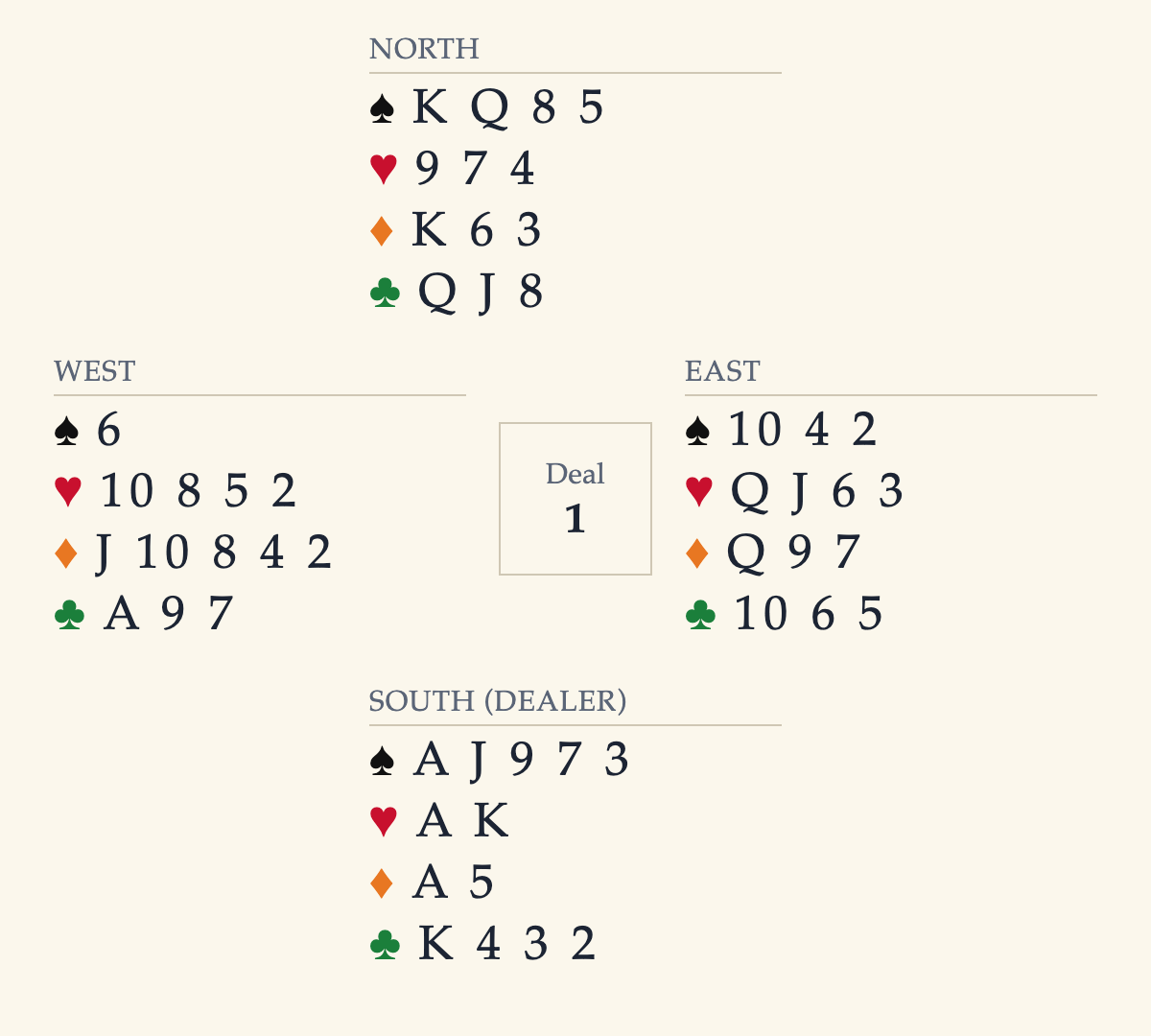
Here is a full hand. South again opens 1♠ and North raises to 3♠, again with 11 points.
| South | West | North | East |
|---|---|---|---|
| 1♠ | Pass | 3♠ | Pass |
| 4NT* | Pass | 5♣* | Pass |
| 5♦* | Pass | 6♦* | Pass |
| 6♠ | All pass | ||
* alert: artificial call.
South counts three key cards and bids 4NT*. North's 5♣* means one or four, and since South holds three, it is one: the ♠K. That is four of the five key cards, with only the ♣A missing, so the small slam is on. The pair holds nine trumps, and South lacks the ♠Q, so South asks with 5♦*. North holds the ♠Q and the ♦K, and answers 6♦*, which says yes to the queen and names the king as well. South bids 6♠.
The opponents hold just one key card, the ♣A, so six is the right level. Double dummy, 6♠ makes with twelve tricks. Seven would need thirteen, and with the ♣A missing there is no reason to try. Key cards tell you what can be cashed, not how many tricks the hand will make.
The King Ask
Once you know all five key cards are in the partnership, 5NT asks about kings. It also promises that all five are there, so partner knows you are thinking about a grand slam. Never bid it with a key card missing. Partner shows specific kings by bidding six of the suit, cheapest first. Classic Blackwood answers the same 5NT with a count, as our Blackwood guide shows. In key card bidding we show suits, because which king partner holds matters more than how many.
It is an information bid, not a promise to bid seven. Here is a hand where the answer says stop.
| Hand | ♠ | ♥ | ♦ | ♣ | High card points |
|---|---|---|---|---|---|
| North | K Q 8 5 | A 9 4 | 7 4 3 | K 6 2 | 12 |
| East | 10 4 | J 10 7 3 2 | K Q 10 | 10 8 4 | 6 |
| South | A J 9 7 3 | K Q 5 | A J 6 | A 5 | 19 |
| West | 6 2 | 8 6 | 9 8 5 2 | Q J 9 7 3 | 3 |
| South | West | North | East |
|---|---|---|---|
| 1♠ | Pass | 3♠ | Pass |
| 4NT* | Pass | 5♠* | Pass |
| 5NT* | Pass | 6♣* | Pass |
| 6♠ | All pass | ||
* alert: artificial call.
North's 5♠* shows two key cards with the ♠Q, which gives North-South all five key cards, since South holds three. South bids 5NT* and North answers 6♣*, the ♣K. South counts twelve winners and no safe thirteenth, and bids 6♠. The double dummy count agrees: twelve tricks, and 7♠ would fail.
1430 vs 0314
The other common scheme is 0314. It swaps the first two steps and leaves everything else alone. Same ask, same queen ask, same king ask. Only the first two answers change.
| Answer (spades trump) | 1430, the Bridge Unleashed standard | 0314 |
|---|---|---|
| 5♣* | 1 or 4 key cards | 0 or 3 key cards |
| 5♦* | 0 or 3 key cards | 1 or 4 key cards |
| 5♥* | 2 key cards, no trump queen | 2 key cards, no trump queen |
| 5♠* | 2 key cards, with the trump queen | 2 key cards, with the trump queen |
Both work. What matters is that you and your partner use the same one, because a pair that mixes them will eventually bid a slam off two missing key cards. Bridge Unleashed teaches 1430. There is a second trap hiding in the first step: in classic Blackwood, 5♣ means zero or four aces. In 1430 it means one or four key cards. Same bid, different message, so agree before you sit down.
What a Void Does to the Answers
A void is worth tricks that the key card count cannot show, so some partnerships let the answer announce it. Ours, with spades as trumps, works like this.
- 5NT* shows an even number of key cards, 0 or 2, plus a void.
- Six of a suit below trumps shows an odd number, 1 or 3, plus a void in the suit bid.
Take ♠ Q 8 6 4 2 ♥ A 9 7 5 ♦ void ♣ K 8 6 3. It holds one key card, the ♥A, and a diamond void, so when partner asks 4NT*, the answer is 6♦*: odd, plus a diamond void. Now take ♠ K 9 7 5 4 ♥ void ♦ A 8 6 3 ♣ Q J 7 5. Two key cards, the ♠K and the ♦A, and a heart void, so when partner asks 4NT*, the answer is 5NT*.
* alert: artificial call.
Here 5NT is an answer, not a question. These answers are rare, and they land at the six level, so they are worth agreeing on ahead of time. If you are the one holding the void and want to ask, that is a different tool, Exclusion Blackwood, which the Let's Go Slammin' workshop replay teaches along with the rest of the slam toolkit.
When 4NT Is Not Roman Key Card Blackwood
With spades agreed, or another suit agreed with Kickback off, 4NT asks for key cards. It is not a key card ask in these cases.
- Over a notrump opening. Partner opens 1NT, showing 15 to 17 points, and you bid 4NT. There is no trump suit, so there is no trump king and nothing to count. The bid is quantitative: "I have about 16 or 17, bid 6NT if you are at the top of your range, pass if you are at the bottom." Opener with 15 passes, and opener with 17 bids 6NT.
- No trump suit agreed. Check that a trump suit really has been agreed before you bid 4NT. If it has not, partner has no trump king to count and may read 4NT as a natural or quantitative bid.
- When the house plays Kickback. In our workshops, with hearts, diamonds or clubs agreed below 3NT, the ask is the suit above trumps instead of 4NT: 4♠ for hearts, 4♥ for diamonds, 4♦ for clubs. The answers start on the step just above the ask, in the same 1430 order. With spades, the suit above is notrump, so Kickback and 4NT are the same bid. If both majors have been bid, Kickback is off and 4NT is the ask.
- 4♣ over notrump. A direct 4♣ over a 1NT opening asks for aces. That is Gerber, not key cards.
The general rule is simple. Spades agreed, or another suit agreed with Kickback off, 4NT is the key card ask. No trump suit, it is a different question.
Common Mistakes
- Counting a side king. With spades trumps, a ♥K is lovely and it is not a key card. It is a common error.
- Asking when the answer cannot help. If you are bidding the slam whatever partner says, bid the slam. If you could not stop below six after hearing the answer, do not ask.
- Playing different schemes. One partner on 1430 and one on 0314 turns 5♣ into a guess.
- Bidding 5NT with a key card missing. The king ask promises all five.
- Asking before you have a fit. Slam bidding starts with an agreed trump suit. Our post on Jacoby 2NT and splinter raises shows how a raise agrees the suit early and leaves room to ask.
Where to Practice
The Let's Go Slammin' workshop replay covers control bids, Roman Key Card Blackwood 1430, quantitative 4NT and Exclusion, with hands to practice on. The 50 Conventions series covers keycard as 1430 in its first week, one convention a day. And if you are building your list from the beginning, our guide to the first five conventions to learn puts Blackwood in order. The bridge glossary defines keycards, cue bids and voids in plain language.
Frequently Asked Questions
What is 1430 in Roman Key Card Blackwood?
1430 is the order of the answers to the 4NT key card ask. With spades as trumps, the first step, 5♣, shows one or four key cards. The second step, 5♦, shows zero or three. The third step, 5♥, shows two key cards without the queen of trumps, and the fourth step, 5♠, shows two with the queen. Bridge Unleashed teaches 1430 as the house standard.
What are the five key cards in Roman Key Card Blackwood?
The four aces and the king of the agreed trump suit. Kings in other suits are not key cards, and neither is the queen of trumps, which is tracked separately with the queen ask.
How do you ask for the queen in Roman Key Card Blackwood?
After partner shows the key card count, the cheapest bid that is not the trump suit asks for the queen of trumps. With spades as trumps, that is 5♦ after a 5♣ answer and 5♥ after a 5♦ answer. Partner bids five of the trump suit with no queen, and any other bid says the queen is there. With ten or more trumps between the two hands, skip the queen ask.
What is the difference between 1430 and 0314?
The first two steps are swapped. In 1430, 5♣ shows one or four key cards and 5♦ shows zero or three. In 0314, 5♣ shows zero or three and 5♦ shows one or four. The third and fourth steps are the same in both: two key cards without the queen, then two with it. Either scheme works, as long as both partners play the same one.
What does 5NT mean after Roman Key Card Blackwood?
5NT asks for kings, and it promises that all five key cards are in the partnership, so it is a grand slam try. In the house version, partner shows specific kings by bidding six of the suit, cheapest first, instead of giving a count. If the answer does not give you a safe thirteenth trick, you can still stop in six of the trump suit.
Is 4NT always Roman Key Card Blackwood?
No. 4NT asks for key cards when spades are the agreed trump suit, or when another suit is agreed with Kickback off. Over a notrump opening, with no trump suit, it is quantitative: an invitation to bid 6NT, not a question about key cards. Pairs who play Kickback ask with the suit above trumps for hearts, diamonds and clubs, such as 4♠ for hearts, instead of 4NT.
Roman Key Card Blackwood 1430 is five key cards, four answers, and one rule: count what is missing. Learn it once with a partner, and the next time a slam is possible you will know quickly whether to go or to stay.
