Opening Leads in Bridge: What to Lead and Why
By Tracey Bauer
Opening leads in bridge are chosen before dummy, the hand laid face up on the table, appears, and a good one can set up tricks before declarer, the player who plays the contract, has made a plan. The opening lead is the first card of the hand, played by the defender on declarer's left. Against notrump, lead the fourth-highest card from your longest and strongest suit, unless you hold a three-card sequence such as K-Q-J or J-10-9, in which case lead the top one. Against a suit contract, lead the top of a sequence, a singleton (a one-card suit) when you still hold a trump to ruff with (to ruff is to play a trump when you have no cards left in the suit led), or the suit partner bid, and never lead low from an ace. Below you will find a lead chart you can save, then three hands with the cards on the page, each one checked double dummy, meaning with all four hands in view.
What Is an Opening Lead in Bridge?
When the auction ends, the player to the left of declarer picks any card from their hand and plays it. Then dummy comes down and declarer sees both hands. You, the leader, see only your own thirteen cards and what the auction told you. That is why the lead is a decision made from clues: the suits your side bid, the suits the opponents bid, and how high they went. If you are new to the game, our beginner's guide to how to play bridge covers tricks, trumps and the auction before you meet leads.
Two questions decide almost every opening lead. Is the contract notrump or a suit? And is there a suit that has earned the lead, because you hold a sequence in it or because partner bid it? The chart below answers both for the common holdings.
The Opening Lead Chart
Here is the chart I use with students. Find your holding in the left column, then read across for notrump or for a suit contract.
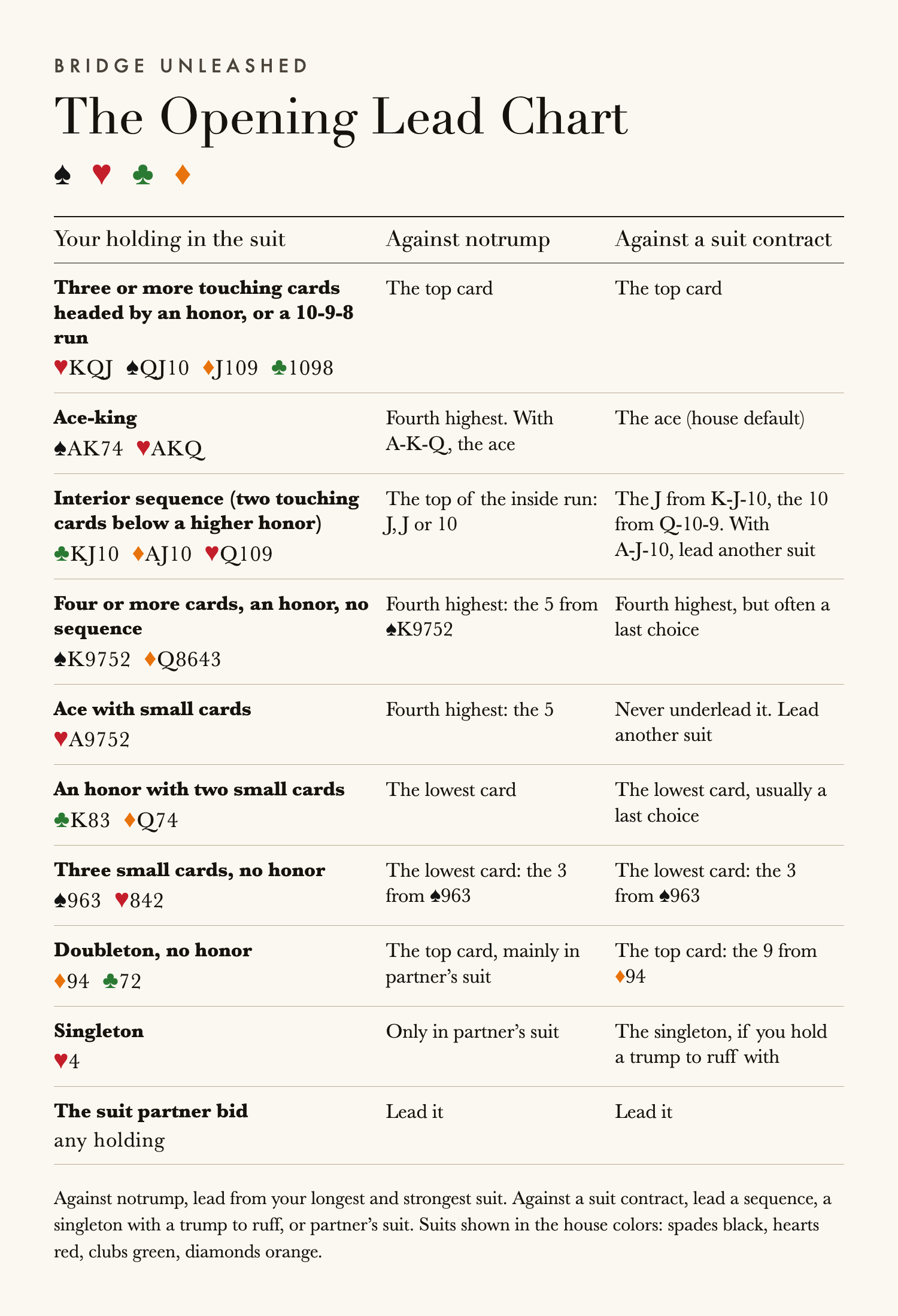
To print it, click the chart to open it on its own, then print that page.
The same chart as text, for screen readers and for copying into your own notes.
| Your holding in the suit | Against notrump | Against a suit contract |
|---|---|---|
| Three or more touching cards headed by an honor, or a 10-9-8 run ♥KQJ ♠QJ10 ♦J109 ♣1098 | The top card | The top card |
| Ace-king ♠AK74 ♥AKQ | Fourth highest. With A-K-Q, the ace | The ace (house default) |
| Interior sequence (two touching cards below a higher honor) ♣KJ10 ♦AJ10 ♥Q109 | The top of the inside run: J, J or 10 | The J from K-J-10, the 10 from Q-10-9. With A-J-10, lead another suit |
| Four or more cards, an honor, no sequence ♠K9752 ♦Q8643 | Fourth highest: the 5 from ♠K9752 | Fourth highest, but often a last choice |
| Ace with small cards ♥A9752 | Fourth highest: the 5 | Never underlead it. Lead another suit |
| An honor with two small cards ♣K83 ♦Q74 | The lowest card | The lowest card, usually a last choice |
| Three small cards, no honor ♠963 ♥842 | The lowest card: the 3 from ♠963 | The lowest card: the 3 from ♠963 |
| Doubleton, no honor ♦94 ♣72 | The top card, mainly in partner's suit | The top card: the 9 from ♦94 |
| Singleton ♥4 | Only in partner's suit | The singleton, if you hold a trump to ruff with |
| The suit partner bid any holding | Lead it | Lead it |
Two notes on the chart. First, leads from small cards are habits, not laws: from three small cards we lead the lowest card, and some partnerships prefer the top or the middle one. A lead you and your partner have agreed beforehand beats a textbook lead you have not. Second, ace-king is where partnerships differ most. Against a suit contract, our house default is the ace, and some partnerships lead the king instead. Either works once you both know which.
Opening Leads Against Notrump
Notrump contracts are a race. Against 3NT, declarer needs nine tricks and the defense needs five, and the quickest way to get five is usually a long suit that you can set up before declarer runs out of tricks of their own. So against notrump you lead from your longest and strongest suit. Strength means high cards plus useful middle cards such as 9s and 8s: K-9-7-5-3 is a better suit to lead than a five-card suit of 8-6-5-3-2.
Which card from that suit? If you hold a three-card sequence such as K-Q-J or J-10-9, lead the top one. Partner then knows you also hold the card below it. With an interior sequence, use the chart. Otherwise, lead the fourth highest. Count down from the top of the suit: from K-9-7-5-3 that is king, nine, seven, five, so the 5 is your lead. Leading low keeps your honors, and it tells partner you hold at least four cards in the suit. If you would rather compete in the auction than defend, see how to defend against a 1NT opening.
Worked Hand 1: Fourth Highest Against 3NT
South opens 1NT and North uses Stayman to look for a four-card major. South has none, so the auction goes to 3NT. You are West, on declarer's left, and it is your lead.
| West | North | East | South |
|---|---|---|---|
| 1NT | |||
| Pass | 2♣* | Pass | 2♦* |
| Pass | 3NT | All pass | |
* alert: an artificial call. 2♣* is Stayman, asking for a four-card major, and 2♦* answers that South has none. Neither call shows the suit it names.
West holds: ♠ K 9 8 5 3 ♥ K 7 6 ♦ 9 6 ♣ 10 5 2
The lead is the ♠5. Spades are your only five-card suit, and K-9-8-5-3 has no sequence of three, so you count down from the top, king, nine, eight, five, to the fourth card. The tempting alternative is the ♠K, the top of the suit.
The deal was checked double dummy, with all four hands visible and perfect play from everyone. The ♠5 gives the defense five tricks, which beats 3NT by one. In the line the solver plays, partner wins the first trick with the ten, and all five defense tricks come from spades: the ten, the ace, the king, the eight and the nine. The ♠K gives the defense only three tricks, and declarer takes ten. The double dummy numbers also show that on this deal the 9, the 8 and the 3 work as well as the 5, and that a lead in any other suit gives the defense three tricks. The suit mattered more than the card, and the 5 is the card that follows the rule and keeps partner informed.
Opening Leads Against Suit Contracts
A suit contract changes the race. Declarer has trumps to stop your long suit, so a long suit is not automatically the right lead. Look instead for leads that cost nothing or set up tricks quickly:
- The top of a sequence. From Q-J-10 or J-10-9 lead the top card. It cannot easily cost a trick, and it tells partner about the card beneath it.
- Partner's bid suit. If partner bid or overcalled a suit, lead it. Partner has told you where the tricks may be.
- A singleton, if you have a trump to ruff with. A lead that lets you trump a card later can gain a trick, and it works best when partner can win the suit and return it.
- The ace from ace-king. Our house default. From ace-king, lead the ace.
The lead to avoid is the low card from an ace. Against a suit contract we never underlead an ace, because declarer is happy to see you give the ace's power away. Leading low from an unsupported king or queen is also usually a last choice.
Worked Hand 2: Top of a Sequence Against 4♥
South opens 1♥ and North, with four-card heart support and 11 points, makes a limit raise to 3♥. South has extra values and accepts, bidding game. You are West again.
| West | North | East | South |
|---|---|---|---|
| 1♥ | |||
| Pass | 3♥ | Pass | 4♥ |
| All pass | |||
West holds: ♠ Q 4 3 ♥ 10 7 ♦ J 10 9 3 ♣ A Q 8 2
The lead is the ♦J, the top of the J-10-9 sequence. The tempting alternative is the ♣A, because aces feel like cards that should be played early. Double dummy, the ♦J gives the defense four tricks, which beats 4♥ by one. The ♣A gives the defense three tricks, and 4♥ makes. On this deal every diamond lead gets four tricks, so the suit is right and the jack is the card the rule asks for. The ace of clubs has no king beside it, so it captures nothing, and on this deal it costs the defense a trick.
Worked Hand 3: The Singleton Against 4♠
South opens 1♠ and North makes a limit raise, 3♠, with four-card support and 10 points. South accepts and bids 4♠. You are West.
| West | North | East | South |
|---|---|---|---|
| 1♠ | |||
| Pass | 3♠ | Pass | 4♠ |
| All pass | |||
West holds: ♠ 10 4 2 ♥ A 7 6 2 ♦ 5 ♣ K J 9 7 5
The lead is the ♦5, your singleton. You have three trumps to ruff with, and there is no sequence to lead and no ace-king. The other choices are weak: the ♥A is an unsupported ace, the ♥2 underleads that ace, which we never do, and the ♣K starts a suit with no support. Double dummy, the ♦5 gives the defense four tricks and beats 4♠ by one, while each of those three alternatives gives the defense three, and 4♠ makes.
One caveat. The singleton works on this deal because partner holds the ace of diamonds, so partner can win it and give you the ruff. You cannot see that ace at the table. Double dummy shows the lead beats the contract here, but you choose it because it is the lead most likely to work. It fits what the hand offers: a short suit, trumps to ruff with, and nothing better to lead.
Common Opening Lead Mistakes
- Leading the king from a suit with no sequence. Hand 1 shows the cost: the king gave the defense three tricks where a low spade gave five.
- Leading an unsupported ace against a suit contract. Hand 2 shows it: three tricks for the defense, against four from the sequence.
- Underleading an ace against a suit contract. It can let declarer's king or queen win a trick the ace would have taken. Pick a different suit.
- Leading a short suit against notrump, unless partner bid it. Notrump leads come from length. A singleton is a suit-contract lead.
- Ignoring partner's bid. If partner named a suit during the auction, that is your first candidate.
Once the lead is on the table, the next conversation is about signals: what partner does when you lead and they cannot win. That is the subject of our guide to defensive signals and carding, and the declarer's side of the same hand is in the guide to the play of the hand.
Frequently Asked Questions
What is the best opening lead in bridge?
There is no single best card, because it depends on the contract and on your hand. Against notrump, lead the fourth-highest card from your longest and strongest suit, or the top of a three-card sequence. Against a suit contract, look first for the top of a sequence, the suit your partner bid, or a singleton (a one-card suit) when you still hold a trump to ruff with (to ruff is to play a trump when you have no cards left in the suit led).
What do you lead against a notrump contract?
Lead from your longest and strongest suit. If you hold a three-card sequence in it, such as K-Q-J or J-10-9, lead the top one. Otherwise lead the fourth-highest card, so from K-9-7-5-3 you lead the 5.
What does fourth best mean in bridge?
Fourth best, or fourth highest, means counting down from the highest card in the suit to the fourth card and leading it. From K-9-7-5-3 the cards in order are king, nine, seven, five, three, so the fourth best is the five. It keeps your honors at home and tells partner you hold at least four cards in the suit.
Should you lead an ace against a suit contract?
Usually not an ace by itself. Saved, that ace can capture a king or queen later, and leading low from an ace is something we never do against a suit contract. Ace-king is the exception: our house default is to lead the ace from ace-king. In the second worked hand above, leading the ace without its king gave the defense three tricks, while the sequence lead gave four.
When should you lead a singleton?
Against a suit contract, when you hold a trump to ruff with and have a fair chance that partner can win the suit and give you the ruff. It is a good bet, not a guarantee, because you cannot see partner's hand. Against notrump a singleton is not a normal lead, since there is no trump suit to ruff with.
Who makes the opening lead in bridge?
The defender sitting to the left of declarer. Declarer is the first player on the declaring side to name the final suit or notrump, so the opening leader is the player on that declarer's left.
Opening leads are a skill that gets sharper with every deal you defend. Block 4 of Learn Bridge in a Weekend teaches leads and the defenders' rules at the table, so you leave the weekend knowing what to lead and why.
