Lebensohl in Bridge: They Bid Over Your 1NT. Now What?
By Tracey Bauer
Partner opens 1NT. The next player bids 2♠. You have a long ♦ suit and very little strength.
You'd like to play in 3♦. But what would you bid with a strong hand and the same long suit?
If 3♦ can mean either hand, partner has a problem. Pass, and you might miss a game. Bid again, and you might get too high.
Lebensohl gives those hands different ways to bid. Once you see why those routes exist, the convention becomes much easier to remember.
What is Lebensohl?
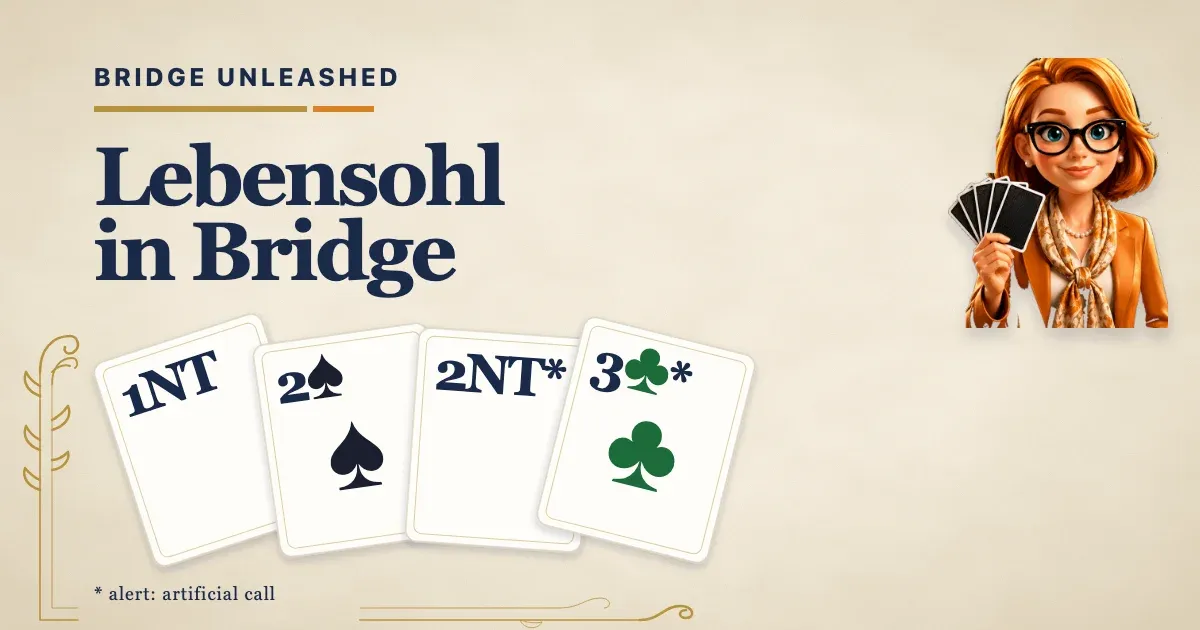
Lebensohl is a partnership agreement that helps you describe your hand after an opponent interferes over your side's 1NT opening. Its central bid is an artificial 2NT*, asking opener to bid 3♣*.
That extra step lets you separate hands that want to stop in a partscore from hands that want to reach game. It also helps you tell partner whether you have a stopper in the opponent's suit.
We'll use our Bridge Unleashed treatment here: partner's 1NT shows 15 to 17 high-card points, and the opponent makes a natural 2♥ or 2♠ overcall. A natural overcall shows the suit actually bid.
The examples assume the opponents pass after that overcall. A star marks an artificial or conventional call; check your event's alert rules.
Start with the problem: one suit, different strengths
After partner opens 1NT and your right-hand opponent bids 2♠, you can no longer bid 2♦.
Your weak ♦ hand still needs somewhere to go. Your strong ♦ hand needs a way to tell partner to keep bidding.
Playing this Lebensohl treatment:
- A direct 3♦ is game forcing. It shows a strong hand with a long ♦ suit. Partner must keep the auction going until you reach game.
- 2NT*, followed by 3♦ over partner's 3♣*, is a weak signoff. You're asking to play in 3♦, and opener passes.
The suit is the same. The route tells partner how much strength you have.
That distinction is useful even before you learn the rest of Lebensohl.
The 2NT relay, one bid at a time
Look at the weak-hand auction:
| Opener | Right-hand opponent | You | Left-hand opponent |
|---|---|---|---|
| 1NT | 2♠ | 2NT* | Pass |
| 3♣* | Pass | 3♦ | Pass |
| Pass | Pass |
Your 2NT* asks partner to bid 3♣*. That request is called a relay.
Partner follows the relay even with only two ♣. The 3♣* bid doesn't promise a ♣ suit. It gives you room to finish describing your hand.
With a weak hand and long ♣, you can pass 3♣*. With a weak hand and long ♦ after their 2♠, you bid 3♦ and stop there.
Notice what you've given up: 2NT is no longer a natural invitation to 3NT in this auction. You and partner both need to know that before you use it.
Does 2NT always show a weak hand?
No. The relay creates room for several messages. Your next bid supplies the meaning.
For example, after a natural 2♥ overcall, you can bid 2♠ directly with a weak hand and a long ♠ suit. You still have room at the two level.
That changes what the slower route can mean:
| After 1NT (2♥) | Your message |
|---|---|
| Direct 2♠ | Weak, to play |
| 2NT*, hear 3♣*, then 3♠ | Invitational with long ♠ |
| Direct 3♠ | Game forcing with long ♠ |
Parentheses mark an opponent's call. The table assumes subsequent opponents pass.
The important question is whether you could have bid your suit at the two level. Over 2♠, you couldn't bid 2♦. Over 2♥, you could bid 2♠.
That explains why going through 2NT* can lead to a weak signoff in one auction and an invitation in another.
What does “slow shows” mean?
Now suppose you have enough strength for game and want to explore 3NT.
You also need to consider the opponent's suit. A stopper is a holding that can prevent the opponents from immediately running that suit. An ace is a clear example.
In the treatment we're using, slow shows a stopper:
- Bid 2NT*, hear partner's 3♣*, then bid 3NT: you show a stopper in their suit.
- Bid 3NT directly: you deny a stopper in their suit.
Both routes show game-going strength. The extra step tells partner who has the stopper.
A direct 3NT doesn't tell partner to ignore the overcall. If opener also lacks a stopper, your partnership needs to look for another game.
Confirm this agreement with partner. Lebensohl has variations, and “slow shows” only helps when you're both playing it the same way.
What if you want to find a major-suit fit?
Lebensohl also includes a Stayman-style question after interference. You ask by bidding the opponent's suit, called a cue bid.
After a natural 2♠ overcall, for example, a 3♠* cue bid asks opener about four ♥ and forces to game.
The stopper message follows the same pattern: a direct cue bid denies a stopper; going through 2NT* and 3♣* before the cue bid shows one.
You can ask about a major-suit fit while giving partner information about the overcalled suit.
What should you discuss with partner first?
Start with the auctions you're most likely to use:
- Does 2NT* ask opener to bid 3♣*?
- Which continuations are weak, invitational, or game forcing?
- Are you playing “slow shows” for both 3NT and cue bids?
- What does a double mean?
- What changes when their overcall is artificial?
That last question matters. An artificial call can show a different suit or more than one suit. Don't automatically apply the examples above to every two-level overcall.
Take a few auctions and explain your bids to each other before your next game. You'll soon hear which agreements need another conversation.
Learn Lebensohl, then put it into practice
Join me for They Bid Over Your 1NT. Now What?, our Lebensohl workshop.
- Live lesson: Monday, November 9, 2026, 3 to 5 PM Pacific.
- Play of the Hand: Wednesday, November 11, 2026, 3 to 5 PM Pacific.
We'll work through the 2NT relay, weak signoffs, invitations, game-forcing bids, “slow shows,” and cue-bid Stayman. We'll also cover responder's double, artificial overcalls, and what changes when your side's 1NT is doubled.
One $25 ticket includes both sessions, recordings, and practice materials. Current VIP members have the workshop included in their membership.