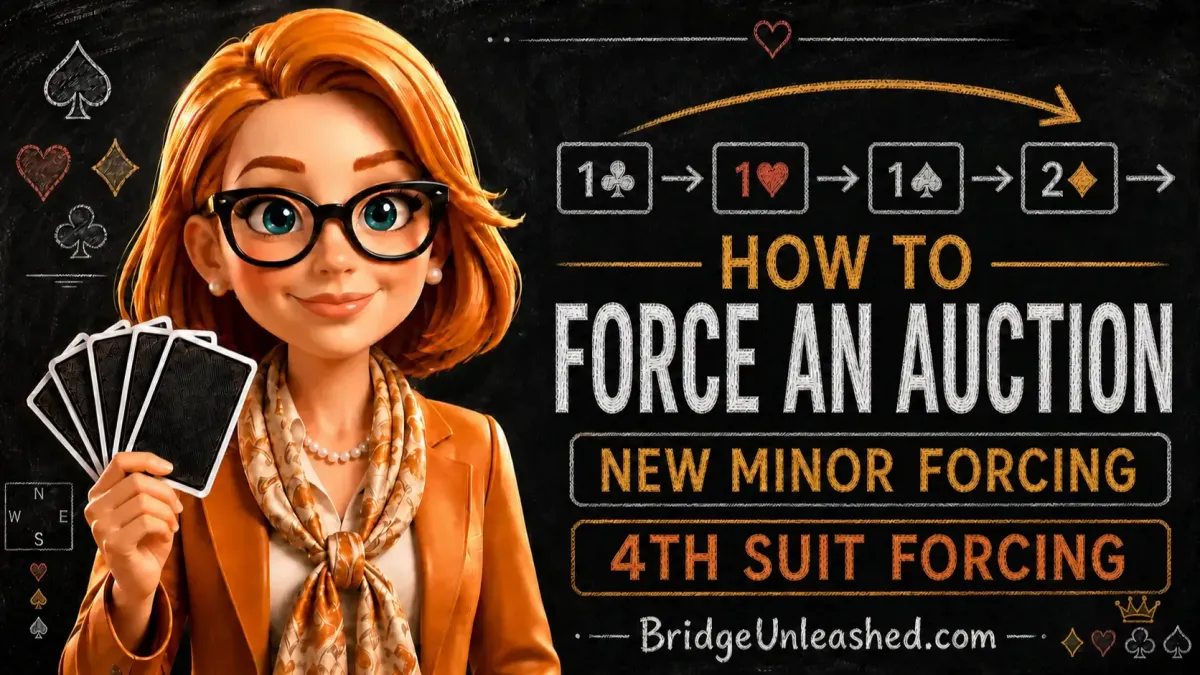
You have enough to keep the auction going, but you still don’t know where to play. Does partner have three cards in your major? Is the unbid suit stopped? The asking bid you need depends on what opener just did: named a second suit or rebid 1NT.
Start with opener's rebid
Compare 1♦ - 1♥ - 1♠ with 1♣ - 1♠ - 1NT. In the first auction, opener has named two suits. In the second, opener has rebid notrump. Responder may have a similar problem in both auctions, but the available asking convention changes.
Fourth Suit Forcing belongs to the first type of auction. New Minor Forcing belongs after opener's 1NT rebid. These examples assume uncontested bidding and an unpassed responder. Competitive and passed-hand auctions need separate agreements.
Fourth Suit Forcing creates a game force
After 1♦ - 1♥ - 1♠ - 2♣, responder has bid the only suit nobody has named. In Tracey's workshop, this fourth-suit bid is artificial and game forcing. It doesn't promise ♣ length or a ♣ stopper. It asks opener to describe the hand further.
That distinction gives a strong responder room to investigate. You might have five ♥ and enough for game, but no clear fit and no ♣ stopper. Jumping straight to 3NT risks choosing a contract before you know whether the opponents can run ♣. Repeating ♥ might leave a better contract undiscovered.
The fourth-suit bid lets you ask without pretending to have a natural ♣ suit. Once you use it in this method, neither partner should stop below game merely because the next bid is inexpensive.
Opener answers with useful information
The workshop's response priorities start with three-card support for responder's major. Next comes a notrump bid with a stopper in the fourth suit. If neither description fits, opener describes extra length or other shape.
For example, 1♦ - 1♥ - 1♠ - 2♣ - 2♥ shows the three-card ♥ support in this treatment. Responder can now evaluate a possible 5-3 fit. The low level of 2♥ doesn't cancel the game force.
With a ♣ stopper and no three-card ♥ support, opener can instead rebid 2NT. Responder then has the information needed to consider 3NT. Without a stopper, opener must choose another description rather than bidding notrump because it is convenient.
Continuation priorities vary between partnerships. Some methods allow a preference on fewer than three cards. The examples here follow the workshop structure, so agree what the support rebid promises before relying on a fit.
Keep the one-level auction separate
In the workshop's starting agreements, 1♣ - 1♦ - 1♥ - 1♠ is natural and forcing for one round. The 1♠ response shows real ♠. It isn't the artificial game-forcing convention described above, which starts at the two level.
Also keep invitational hands out of a game-forcing fourth-suit auction. With enough to invite but not commit to game, choose the appropriate natural invitation for your hand. A convention cannot safely promise more strength simply because you would like the information.
After 1NT, ask with the new minor
Now consider 1♣ - 1♠ - 1NT - 2♦. Opener has rebid 1NT, so 2♦ is New Minor Forcing in this method. The workshop assumes a 12 to 14 point 1NT rebid. That is different from its 15 to 17 point 1NT opening.
Responder's new minor is artificial and asks about the majors. Does opener have three-card support for ♠? Does opener have four ♥? It is especially useful when responder has five cards in the first major and four in the other.
The workshop uses the unbid minor: 2♦ after a 1♣ opening, or 2♣ after a 1♦ opening and a 1NT rebid. Some pairs use a different checkback structure. Don't substitute one of those response tables without agreeing the whole method.
New Minor Forcing leaves room for an invitation
Here, New Minor Forcing starts at about 11 points and is forcing for one round. It handles both invitational and stronger hands; it doesn't automatically create a game force. Responder's continuation must distinguish those strengths.
The workshop gives priority to opener's four-card other major before three-card support for responder's major. After 1♣ - 1♠ - 1NT - 2♦ - 2♥, responder hears four ♥. A possible 4-4 fit has come into view. With an invitational hand, responder can invite; with game-going strength, responder must make that clear.
This is the contrast to remember: Fourth Suit Forcing commits the partnership to game in this treatment. New Minor Forcing asks a question that an invitational hand can also ask. The Two Over One guide offers another look at how an established game force changes later bidding.
Hear the answer, then choose the contract
The Forcing Auctions Workshop replay includes the two-hour lesson and two-hour Play of the Hand: about 4 to 5 hours of video, a 30 to 50 page workbook, a two-page cheatsheet and PBN practice hands, for $25.
Pause before the asking bid and before opener's answer. Then follow how the information changes the final contract. Practice the hands on BBO or BridgeChamp. Use the PBN files in BridgeChamp or another PBN-compatible platform. For BBO, convert them to LIN if its import tool requires that format.
