What Is a Finesse in Bridge? How and When to Take One
By Tracey Bauer
A finesse in bridge is a way to win a trick with a card that is not the highest one left. You lead toward your high card, hoping the defender who holds the missing honor has to play before you do. If that defender plays low, you play your card and it wins. A finesse works about half the time when you have no other clue, so it is a tool for when you are short of tricks, not a habit.
What Is a Finesse in Bridge?
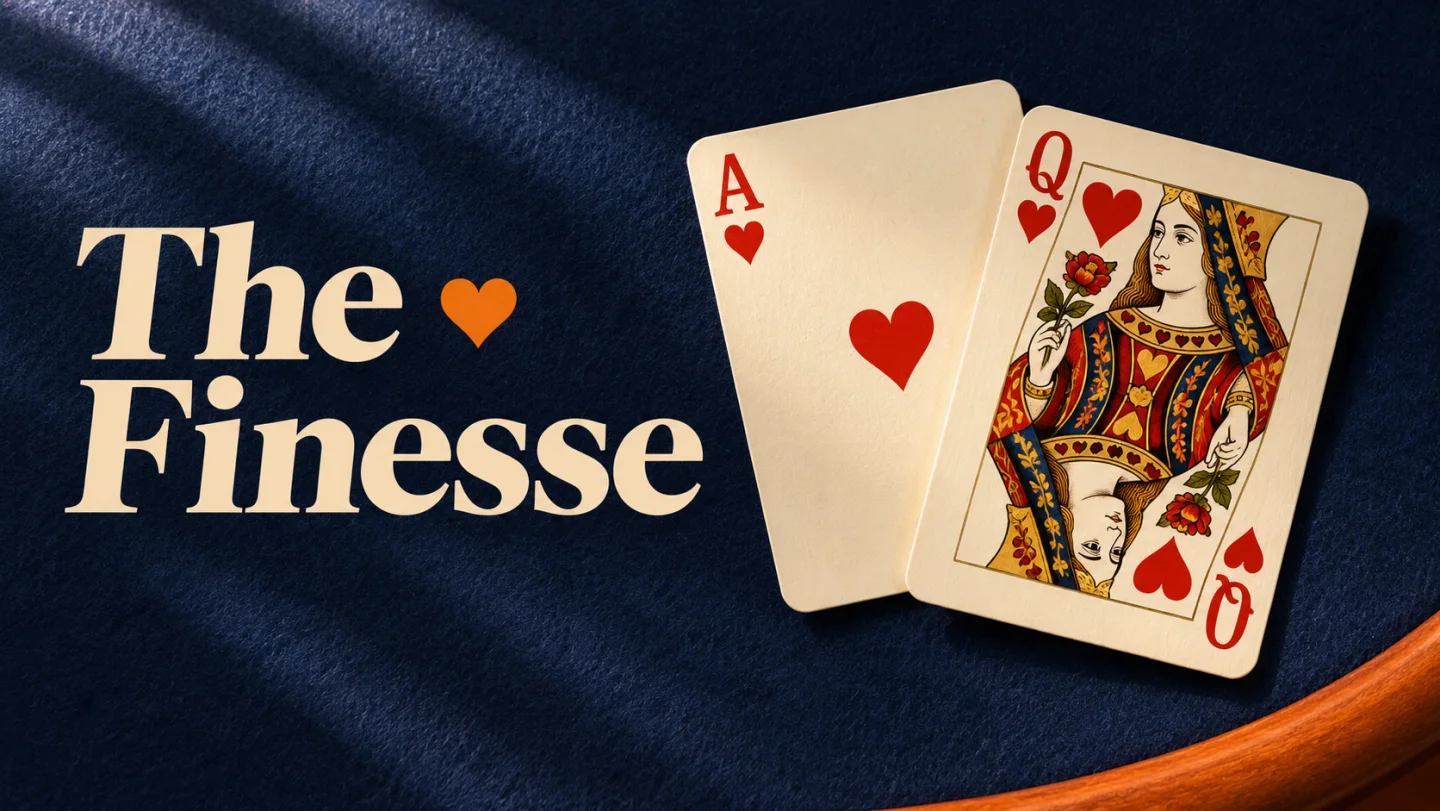
Picture the heart suit. Dummy, the hand laid face up on the table, holds the ace and the queen. You, the declarer, hold three small hearts. The king is missing. If you simply cash the ace, the king stays where it is and wins a trick later. The queen only becomes a winner if the king is in the right place and you make the defender with it play first.
So you lead a small heart from your hand toward dummy. West, the defender on your left, has to play before dummy does. If West plays low, you play dummy's queen. When West holds the king, the queen wins, because West had to commit a card before you chose yours.
That is the whole idea, in one sentence: lead toward the card you hope will win.
How Does a Finesse Work?
Every finesse comes down to the order of play. The four players play to a trick in turn, clockwise. The defender who plays right before your high card is the one who has to guess. The defender who plays right after it gets to wait and see.
- You want the missing honor in front of your high card. Then its owner has to play before you do.
- You lead from the opposite hand. With the ace and queen in dummy, lead from your hand. With the high cards in your hand, lead from dummy.
- You decide last. You play your high card only after you see what the defender in front of it does.
Three Finesses Every Player Should Know
1. Ace-queen, missing the king
Dummy: ♥ A Q Your hand: ♥ 7 6 4
Lead the ♥4 from your hand toward dummy. If West plays low, play the queen. It wins when West holds the king. It loses when East holds the king, and then you still have the ace.
2. Ace-king-jack, missing the queen
Your hand: ♠ A K J 5 Dummy: ♠ 7 4 3
Now the high cards are in your hand, so the lead has to come from dummy. Lead the ♠3 toward your hand. If East plays low, play the jack. It wins when East holds the queen. Lead the jack from your own hand instead, and East just covers it with the queen.
This finesse has a catch: you need a way to get to dummy first. A card that wins a trick in the hand you want to lead from is called an entry. Before you lead toward your honors, ask how you will reach the hand you lead from. Entry first, finesse second, top cards after.
3. Ace-queen-jack, missing the king: the repeated finesse
Dummy: ♣ A Q J Your hand: ♣ 5 4 2
When you need two extra tricks from one suit, take the finesse twice. Lead toward the queen and play it if West plays low. Then get back to your hand and lead toward the jack. If West holds the king, both finesses win and you take three club tricks.
Each finesse needs its own lead from your hand, so count your entries before you start. Spend an entry early on a card you could have saved, and you may have no way back for the second finesse.
Common Finesse Mistakes
- Leading the high card instead of leading toward it. Lead the queen from dummy's ace-queen and East plays, then you, then West. West has the last word, and the king takes your queen.
- Cashing the ace and hoping the king drops. It only falls if it is alone. Most of the time the king stays put and wins later.
- Forgetting the entry. The right finesse from the wrong hand is the wrong finesse. Plan how you will get there before you play to trick one.
- Taking a finesse you don't need. More on that next.
When Should You Not Take a Finesse?
Ask one question before any finesse: do I need it? Start by counting your sure winners, the tricks you can take without giving up the lead. Our guide to planning the play of a bridge hand walks through that count.
If you already have the tricks for your contract, a finesse can only add an overtrick, and a losing one can hand the lead to the wrong defender. That defender is the danger hand: the one with a long suit ready to run once they get in. In 3NT with nine sure tricks and the opponents' long suit set up against you, take your nine. Giving the danger hand the lead for a tenth trick can cost the contract.
A finesse is a good tool when you're short. When you already have your tricks, take them.
Prefer to Watch?
In this lesson I play four full deals: the ace-queen finesse, the ace-king-jack finesse with an entry, the repeated finesse, and a hand where the finesse is the wrong play.
Frequently Asked Questions
What is a finesse in bridge?
A finesse is a way to win a trick with a card that is not the highest one left. You lead toward your high card, hoping the defender who holds the missing honor has to play before you. If that defender plays low, your card wins.
Does a finesse always work?
No. With no other clue, a simple finesse works about half the time, because the missing honor is equally likely to be with either defender. The bidding or the play so far can change those odds.
Why do you lead toward the high card instead of leading it?
Because the defender who plays after your high card gets to wait. Lead toward it, and the defender in front of it has to play first, so you choose your card after you see theirs.
What is a repeated finesse?
A repeated finesse is taking the same finesse twice in one suit, such as leading toward an ace-queen-jack two times. It can win two extra tricks, and it needs an entry back to the leading hand for each finesse.
What is an entry in bridge?
An entry is a card that wins a trick in a particular hand, so that hand can lead next. Many finesses need an entry to dummy or to your own hand before you can lead toward your high cards.
When should you not take a finesse?
When you already have enough tricks for your contract, and a losing finesse would give the lead to the defender with a long suit ready to run. Count your sure winners first, and finesse only when you are short.
New to declarer play? Start with our free path to learn bridge, then practice finesses against robots on bridgechamp.com, or on BBO if you'd rather. For the whole game in one course, Learn Bridge in a Weekend is $97 and self-paced.