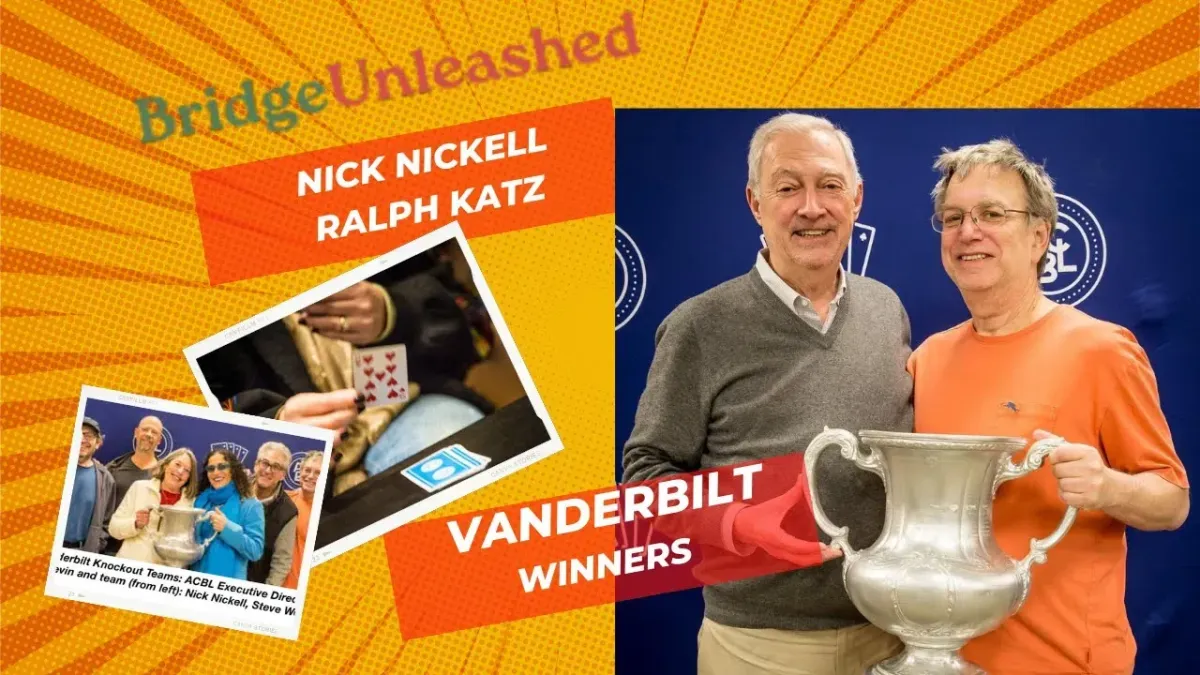
Mastering the Game: Dynamic Bridge Partnership of Katz & Nickell
In the rarified world of championship contract bridge, where split-second decisions and unspoken communication can mean the difference between triumph and defeat, few partnerships have achieved the sustained excellence of Ralph Katz and Nick Nickell. Their collaboration represents more than just an impressive trophy collection—though their four Bermuda Bowl victories speak volumes. It's a masterclass in resilience, mutual respect, strategic adaptation, and the psychological sophistication required to maintain elite performance under pressure.
For aspiring bridge players and established partnerships alike, the Katz-Nickell collaboration offers invaluable lessons that transcend card play mechanics. Their journey demonstrates how the finest partnerships are built not merely on technical skill, but on emotional intelligence, systematic preparation, and the ability to transform adversity into strength.
A Partnership Born from Tragedy and Transformation
The genesis of the Katz-Nickell partnership emerged not from a casual social game or a planned trial partnership, but from heartbreaking circumstances that would have derailed lesser teams. When Nick Nickell's long-time partner Richard Freeman passed away suddenly, the Nickell team faced an immediate crisis with world championship qualifying on the horizon.
"Ralph was the clear winner," Nick recalls when describing how the team filled this irreplaceable void. "We had the entire team rank their top choices, and Ralph came out on top for everyone." This wasn't merely about finding a technically competent player—the team needed someone who could seamlessly integrate into their established dynamics while bringing his own strengths to the partnership.
Katz's reputation preceded him. Known throughout the bridge community for his sophisticated card play, strategic thinking, and notably calm demeanor at the table, he represented exactly what the team needed during this emotionally charged transition. The fact that all team members independently identified him as their first choice speaks to the respect he'd earned across decades of high-level competition.
Yet even with unanimous support and Ralph's established credentials, partnerships aren't plug-and-play propositions in championship bridge. The pressure of replacing a beloved partner, combined with the immediate stakes of international competition, created a challenging initiation for the new pairing.
The Rocky Beginning That Forged Resilience
Their first major tournament together didn't go according to plan. Miscommunications occurred. Signals were misread. The seamless coordination that characterizes elite partnerships was, predictably, absent. For many pairings, such a difficult debut might have sparked doubts about long-term compatibility.
Instead, Katz and Nickell recognized these early struggles as the inevitable growing pains of any new partnership, regardless of individual skill levels. Rather than questioning their decision, they committed to the systematic work required to transform two excellent individual players into a cohesive unit.
"We quickly found our rhythm," Nick notes, attributing their recovery to a shared foundational philosophy that would become central to their success: when in doubt, never assume your partner sees the situation the same way you do.
This principle might sound obvious, yet it's violated constantly even among experienced players. The assumption that "partner should have known what I meant" or "any competent player would have made that play" poisons partnerships at every level. Katz and Nickell instead embraced the reality that bridge is played through two different perspectives at the table, and those perspectives don't always align without explicit communication and mutual understanding.
7 Partnership Principles That Define Championship Bridge
1. Assume Nothing About Partner's Perspective
The foundational principle of the Katz-Nickell partnership is their refusal to assume identical perception of any situation. When a bid or play seems ambiguous, they discuss it afterward without accusation. This approach eliminates the toxic pattern of "you should have known" that destroys so many promising partnerships. They recognize that bridge is essentially a game of incomplete information, and even excellent players can reasonably interpret the same auction or position differently.
2. Preparation Without Over-Preparation
While their bidding notes have evolved into extensive documentation over the years, Katz and Nickell have learned the art of strategic preparation. "Our notes are too long and too extensive," Nick admits with characteristic self-awareness. They've learned to identify which agreements require pre-tournament rehearsal versus situations where their general partnership understanding and table judgment suffice. This prevents analysis paralysis while ensuring they're aligned on critical sequences.
3. Positivity as Performance Strategy
"Get up and get a glass of water. If it's really bad, get a beer," Nick advises when asked about handling disasters at the table. This light-hearted approach reflects their broader strategic commitment to emotional regulation. They understand that bridge is a game of sessions and matches, not individual boards. Allowing one terrible result to affect subsequent decisions creates a cascading failure pattern. Their ability to compartmentalize bad results and maintain positive focus is as crucial to their success as their technical skills.
4. Mutual Accountability Without Blame
When things go wrong—and even for champions, things regularly go wrong—Katz and Nickell share a remarkable approach: "We both try to take the blame," Nick explains. This isn't about avoiding responsibility; it's about recognizing that most bridge disasters involve contribution from both partners. This mutual accountability eliminates the defensive posturing that prevents honest analysis and improvement.
5. Timing Disagreement Discussions Strategically
The pair has established a firm principle about conflict resolution: never at the table. When disagreements arise about a bidding judgment or defensive decision, they table the discussion until later when emotions have settled and they can analyze objectively. This prevents the emotional escalation that turns analytical discussions into personal conflicts. The practice of open, honest communication conducted away from the heat of competition has solidified their partnership through countless potential friction points.
6. Continuous Evolution of System and Style
Rather than rigidly adhering to a system developed years ago, Katz and Nickell continuously refine their methods based on experience and changing competitive environments. Their willingness to trim unnecessary complexity from their notes while incorporating new theoretical developments keeps their system fresh and optimally suited to their current partnership dynamics.
7. Respect for Each Other's Strengths
Championship partnerships work when each player understands and defers to their partner's particular strengths. Katz and Nickell have developed implicit trust in each other's judgment across different types of situations, allowing them to leverage their combined expertise rather than second-guessing each other's decisions.
The Psychology of Championship Performance
What separates good partnerships from great ones often has nothing to do with bidding systems or card play technique. The psychological dimension of partnership bridge—especially at championship level—determines who maintains performance under crushing pressure.
Emotional Regulation Under Pressure: When playing for a national championship or world title, the pressure to perform flawlessly is enormous. Every bid, every card played, faces immediate scrutiny from teammates, opponents, and kibbitzers. The ability to maintain clear thinking and emotional equilibrium while feeling that pressure separates champions from nearly-champions. Katz and Nickell's established routines for resetting after bad boards—getting up, taking a break, consciously choosing to refocus—represent sophisticated emotional regulation techniques.
The Trust Foundation: Trust in partnership bridge operates on multiple levels. There's technical trust—confidence that partner understands your agreements and will execute them correctly. There's judgment trust—belief that when partner makes an unexpected decision, they have good reason even if you can't immediately see it. And there's emotional trust—security that partner won't blame you for honest errors or withdraw support during rough stretches. Katz and Nickell have built all three types of trust through years of consistent behavior that reinforces reliability.
Managing Success and Failure with Equal Grace: Interestingly, managing success can be as challenging as managing failure. After a brilliant result, the temptation to over-confidence or relaxed concentration can be as destructive as the despair following a disaster. Champions develop consistent emotional responses that don't swing wildly between these extremes. The Katz-Nickell approach of treating both successes and failures as information rather than ego-inflating victories or devastating defeats allows them to maintain optimal performance focus across long tournaments.
Preparation Meets Flexibility: The Strategic Balance
The tension between systematic preparation and adaptive flexibility challenges every serious partnership. Over-preparation can create rigidity that fails when unexpected situations arise. Under-preparation leaves partnerships vulnerable to miscommunications in critical moments.
Katz and Nickell have found their personal balance through years of experimentation. They maintain extensive documentation of their agreements—bidding treatments, carding agreements, defensive principles, and partnership understandings. This documentation provides a foundation that prevents the "I thought we played it this way" disasters that plague less-prepared partnerships.
However, they've also learned that trying to memorize every nuance of their extensive notes creates diminishing returns. Instead, they focus pre-tournament preparation on:
High-frequency situations that appear regularly and carry significant consequences. Recent additions or modifications to their system that haven't yet become automatic. Specific vulnerabilities they've identified from recent play or that might be exploited by upcoming opponents. General strategic review of their approach to different types of competitive situations.
This targeted preparation strategy keeps them sharp on what matters most while avoiding the mental fatigue of trying to review every detail of their system before every event.
The flexibility component comes through their shared understanding that when unexpected situations arise—as they constantly do in bridge—they trust their partnership instincts and general principles rather than freezing because "we haven't discussed this specific situation." Their years together have built sufficient shared bridge logic that they can often navigate novel situations successfully by making the bid or play that fits their general approach, trusting partner to interpret it correctly.
The Communication Architecture of Elite Partnerships
While much bridge communication happens through the formal system of bids and card plays, elite partnerships develop additional layers of understanding that casual observers might miss.
Tempo and Rhythm: The pace at which bids are made or cards are played conveys information—though ethical players ensure their tempo doesn't inappropriately communicate unauthorized information. Nonetheless, partners who play together regularly develop sensitivity to each other's thinking patterns that helps them navigate complex situations.
Post-Session Analysis: Perhaps the most underrated aspect of championship partnerships is what happens away from the table. Katz and Nickell's practice of reviewing difficult hands and discussing alternative approaches serves multiple functions. It ensures they learn from each session rather than repeating mistakes. It verifies that they share the same understanding of their agreements. And it provides a structured outlet for any frustrations, preventing them from festering.
Implicit Understanding Development: After thousands of hands together, elite partnerships develop intuitive understanding of how partner thinks about certain types of problems. While they never assume this understanding is perfect (returning to their core principle), they benefit from sophisticated pattern recognition about each other's decision-making processes.
Lessons for Aspiring Partnerships at Every Level
While most bridge players will never compete for a Bermuda Bowl, the principles that guide the Katz-Nickell partnership apply equally at club games and regional tournaments.
Start with Explicit Agreements: Don't assume you and partner are on the same page about basics. Discuss and document your agreements, even if they're simple. The process of explicit discussion prevents the "I thought we played it that way" disasters that destroy partnerships.
Develop a Blame-Free Culture: Mistakes are inevitable in bridge. Partnerships that make mistakes learning opportunities rather than occasions for criticism improve faster and enjoy the game more. Follow the Katz-Nickell model of mutual accountability.
Create Reset Routines: Develop personal techniques for emotionally resetting after bad boards. This might be physical (getting up, stretching), mental (deliberate refocusing), or social (brief pleasant conversation with partner). What matters is having a consistent process that prevents one disaster from cascading into multiple bad boards.
Review and Evolve: Set aside time after tournaments or weekly games to review interesting hands. This doesn't need to be exhaustive analysis—even 15 minutes discussing 2-3 challenging situations builds partnership understanding and prevents repeated mistakes.
Communicate Away from the Table: Don't wait until you're in the heat of competition to discover disagreements about agreements or approach. Regular discussions about system, strategy, and partnership dynamics—conducted when emotions aren't elevated—prevent problems from emerging at critical moments.
Balance System Complexity with Comfort: While it's tempting to adopt every sophisticated convention, partnerships perform best with systems that match their actual comfort level and frequency of play. A simpler system played with confidence and mutual understanding outperforms a complex system that partners haven't truly mastered.
When the Zombie Apocalypse Comes: Perspective and Humor
In a light-hearted moment, when asked which bridge skills might prove useful during a zombie apocalypse, Ralph Katz responded with characteristic humor: "Nobody's ever asked me that one. How about I have no idea?"
This exchange reveals something important about championship partnerships—they don't take themselves too seriously despite the serious business of championship competition. The ability to maintain perspective, find humor, and remember that bridge is ultimately a game contributes to longevity in any partnership.
The blend of serious competitive commitment with genuine enjoyment of the game and friendship characterizes the most successful long-term partnerships. Katz and Nickell compete fiercely but remember that the relationships built through bridge—with partner, teammates, and the broader community—matter beyond any trophy.
The Enduring Legacy of Championship Partnership
The Katz-Nickell partnership stands as one of bridge's great collaborations not merely because of their impressive results, though four Bermuda Bowls represent an extraordinary achievement. Rather, their legacy lies in demonstrating how exceptional partnerships are built: through mutual respect, systematic preparation balanced with flexibility, emotional intelligence, clear communication, and the ability to transform inevitable challenges into opportunities for growth.
For bridge players at every level, their example provides a roadmap. Whether you're playing club games, regionals, nationals, or competing internationally, the principles remain constant. The finest partnerships aren't born from natural talent alone—they're cultivated through intentional practices that value relationship as much as technical skill.
As bridge continues to evolve through new generations of players and technological innovations that change how the game is learned and practiced, the fundamental truths about partnership excellence remain. The Katz-Nickell collaboration reminds us that behind every great result sits the often-invisible work of building trust, establishing clear communication, managing emotions, and maintaining mutual support through both triumphs and setbacks.
Their partnership proves that in bridge, as in life, the strongest foundations are built not on never having problems, but on having systematic, respectful ways of working through the problems that inevitably arise.
About the Author: Tracey Bauer is a member of the World Bridge Federation (WBF), United States Bridge Federation (USBF), and American Contract Bridge League (ACBL) with over 20 years of playing experience. Through Bridge Unleashed, she combines 30 years of marketing and technology expertise with her passion for bridge to help modernize the game through AI innovation, video content, social media, and strategic marketing for clubs and organizations.
Want to strengthen your bridge partnership? Contact Bridge Unleashed to explore coaching, partnership development resources, and strategies for competitive excellence.
FAQ SECTION (8 QUESTIONS)
Q1: How long does it take to develop a championship-level bridge partnership? There's no fixed timeline, but most elite partnerships require 2-3 years of regular play to develop the intuitive understanding and trust that characterizes championship performance. However, the foundational elements—clear agreements, mutual respect, and good communication—can be established much faster and immediately improve results.
Q2: What's the most common reason bridge partnerships fail? Poor communication and blame culture destroy more partnerships than technical incompatibility. When partners criticize each other's errors rather than focusing on joint improvement, resentment builds and performance suffers. Successful partnerships like Katz-Nickell create blame-free environments where mistakes become learning opportunities.
Q3: Should I play with one regular partner or multiple partners? For serious improvement and competitive success, a regular partnership offers significant advantages. The mutual understanding and trust developed through consistent play together can't be replicated in casual pickup partnerships. However, playing occasionally with others can provide fresh perspectives and prevent stagnation.
Q4: How often should bridge partners review their system and agreements? Regular review is essential but the frequency depends on how often you play. Partners who play weekly should review after each game or at least monthly. Those who play less frequently should review before each tournament and after completing significant events. The key is making review systematic rather than only addressing problems reactively.
Q5: What should I do if my partner and I have very different playing styles? Different styles can actually complement each other if both partners respect the differences and establish clear agreements about how to handle situations where styles clash. Katz and Nickell succeed partly because they've identified each other's strengths and defer to them appropriately. Discuss your differences explicitly and find compromise approaches you're both comfortable with.
Q6: How do I bring up partnership problems without creating conflict? Frame discussions around improvement rather than blame, and focus on specific situations rather than generalities. Instead of "you always overbid," try "let's discuss how we handle borderline game decisions." The Katz-Nickell approach of mutual accountability—sharing responsibility for problems—creates a safer environment for honest discussion.
Q7: Is it better to play a complex system or a simple one? The best system is one both partners thoroughly understand and execute comfortably. A sophisticated system played with uncertainty performs worse than a simpler system played with confidence. As partnerships mature and play more frequently, natural evolution toward greater complexity may occur, but never sacrifice comfort for theoretical sophistication.
Q8: How important is social compatibility in bridge partnerships? While you don't need to be best friends with your partner, mutual respect and basic social compatibility matter significantly. Partnerships that genuinely like each other tend to communicate more openly, handle stress better, and maintain longevity. The friendship between Katz and Nickell clearly contributes to their sustained success and enjoyment of competition together.
